
Want to Start a Business but Have No Ideas? 7 Simple Steps
If you keep thinking "I want to start a business but have no ideas," you are not alone. Many people feel ready to work for themselves but freeze when it is time to pick what to sell. The blank page can make you feel stuck before you even begin.
The good news is that you do not need a flash of genius. You need a simple process. This guide walks you through how to find a business idea that fits your skills, test it before you spend real money and turn it into a business that can actually run.
Quick Answer
If you want to start a business but have no ideas, start with what you already know. Then look for problems people will pay to solve:
List your skills, experience and interests.
Write down problems you see at work, at home and in your community.
Match your skills to those problems.
Talk to potential customers and test demand before you spend money.
Pick one idea and start small.
Why Having No Business Idea Is Normal
Most successful businesses do not start with a brand new invention. They start with a common problem and a better way to solve it. A bookkeeper who helps busy contractors, a cleaning service with reliable scheduling or a consultant who fixes messy sales processes all solve problems that already exist.
So if you have no idea yet, it usually means you are looking in the wrong place. You are searching for something new when you should be searching for something needed.
Where good business ideas usually come from
Strong ideas tend to come from four places:
Your skills. What do people already ask you for help with?
Your work experience. What do you know about an industry that outsiders do not?
Daily frustrations. What wastes your time or money every week?
Changes in the market. What new needs are showing up as technology, rules or habits change?
When one of these overlaps with something people will pay for, you have the start of a real business idea.
7 Steps to Find a Business Idea When You Have None
Follow these steps in order. Each one narrows your options until you have one idea worth testing.
Step 1: Take an honest skills inventory
Write down everything you are good at. Include job skills, certifications, hobbies and the things friends ask you to help with. Next to each one, note how much you enjoy it.
Why it matters: A business built on your strengths is easier to start and easier to keep going.
Mistake to avoid: Do not skip skills that seem "too simple." Organizing files, planning events or explaining technology can all become paid services.
Step 2: Keep a problem journal for two weeks
Carry a note on your phone. Every time you or someone else complains about something, write it down. Pay attention to slow service, confusing processes and tasks people hate doing.
Why it matters: Every business is a solution to a problem. The more problems you notice, the more ideas you will have.
Mistake to avoid: Do not judge ideas while collecting them. Gather first and filter later.
Step 3: Look at industries you already know
Your past jobs are full of clues. Think about the tools, services and support your old employer paid for. Small businesses in that industry likely need the same things.
For example, someone who worked in an accounting office knows that many firms struggle with client onboarding during tax season. That insight could become a service business.
Mistake to avoid: Do not assume you need to leave your industry to start a business. Your inside knowledge is an advantage.
Step 4: Match your skills to real problems
Put your skills list next to your problem journal. Draw lines between the two. Each connection is a possible business idea.
Aim for three to five ideas at this stage. Fewer than three gives you no choice. More than five makes it hard to focus.
Mistake to avoid: Do not pick an idea only because it looks popular online. Popular often means crowded.
Step 5: Research the market
For each idea, find out who your customers would be, what they currently use and what they pay. Look at competitors and read their reviews to see what customers complain about.
The U.S. Small Business Administration has a helpful guide on market research and competitive analysis that explains how to study your customers and competitors.
Why it matters: Research shows you whether people already spend money on this problem. Competition is often a good sign, because it proves demand exists.
Mistake to avoid: Do not stop at online research. Data tells you what is happening, but conversations tell you why.
Step 6: Test demand before you spend money
Talk to at least 10 people who fit your target customer. Ask about their problem, how they solve it today and what a better solution would be worth to them.
Then try a small test. You can offer the service to a few first clients, create a simple one page offer or take preorders. A real "yes" with money attached is the strongest proof you can get.
Mistake to avoid: Do not ask friends "Would you buy this?" Most people say yes to be kind. Ask what they have paid for in the past instead.
Step 7: Choose one idea and start small
Pick the idea with the best mix of demand, fit with your skills and ease of starting. Then commit to it for a set period, such as 90 days, before you judge the results.
Why it matters: Focus builds momentum. Splitting your time across three ideas usually means none of them get a fair chance.
Mistake to avoid: Do not wait for the perfect idea. A good idea with a clear plan beats a perfect idea that never launches.
How to Compare Your Business Ideas
Once you have three to five ideas, score each one from 1 to 5 on the questions below. The idea with the highest total is usually the best place to start.
Question | What a high score means |
|---|---|
Do people already pay to solve this problem? | Customers spend money on it today |
Does it use my skills and experience? | You can deliver it well from day one |
Can I start with a small budget? | Low startup costs and little equipment |
Can I reach customers easily? | You know where your buyers spend time |
Will I enjoy doing this for years? | The work energizes you rather than drains you |
Can it grow beyond just me? | The work can be turned into a process others can follow |
Example: turning a skill into a business idea
This is a made up example to show the process, not a real client.
Maria worked as an office manager for eight years. She had no business idea, so she kept a problem journal. She noticed that three local contractors she knew all struggled to send quotes on time and follow up with customers.
Maria matched this problem with her strongest skills: organization, scheduling and customer communication. She talked to 12 contractors and found that most of them lost jobs because of slow follow up. Two agreed to pay her for a one month trial. That paid trial gave her proof of demand before she spent money on a website or branding.
Red flags to watch for
Nobody will pay for it. Interest is not the same as demand.
You need a large budget before your first sale. Start with a version you can test cheaply.
You cannot explain it in one sentence. If you cannot explain it, customers will not understand it either.
You chose it only because it is trending. Trends fade, but real problems stay.
It depends on you doing everything forever. That is a job, not a business.
What to Do After You Find Your Business Idea
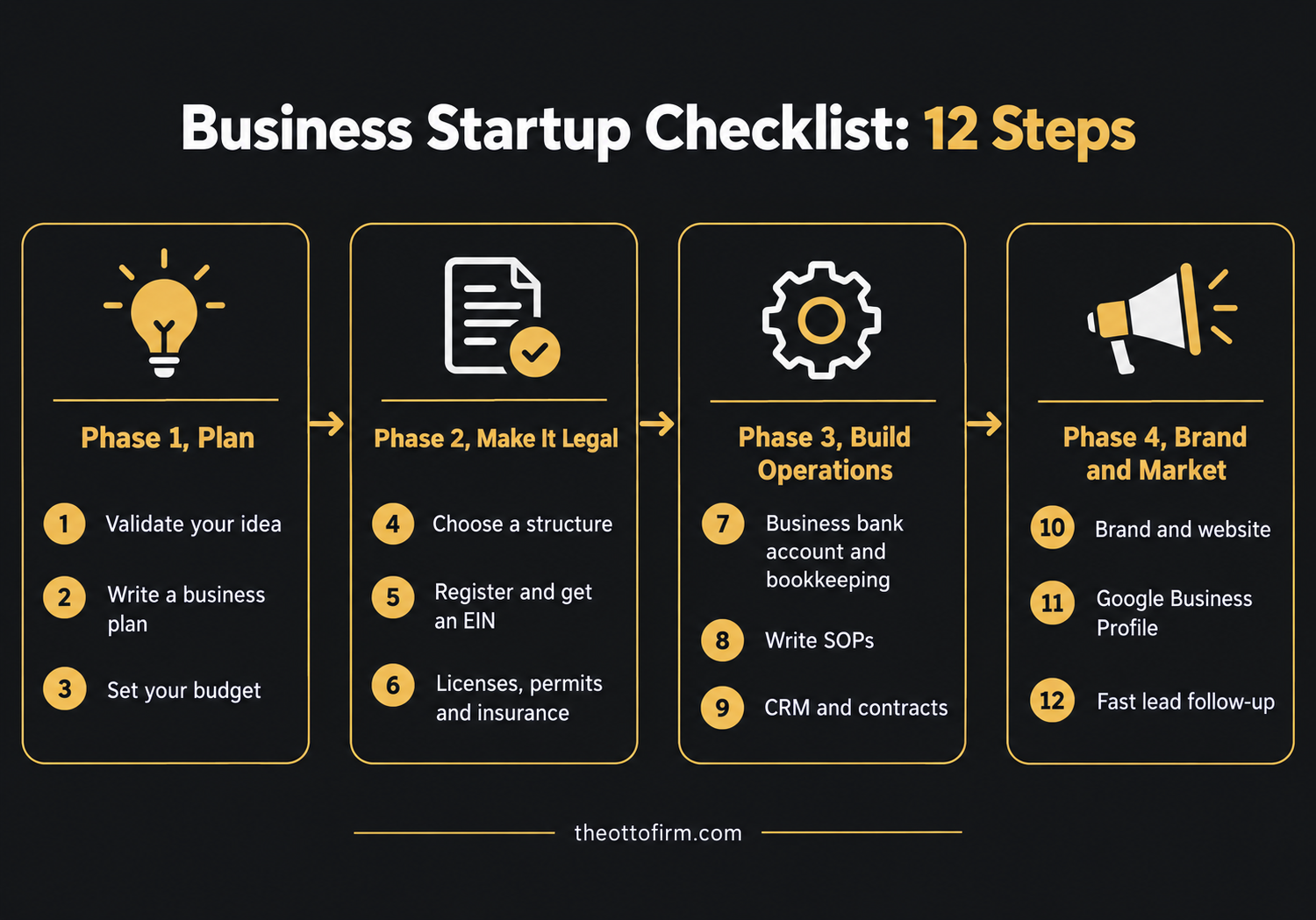
Finding an idea is only the first part. Many new owners stall here because they do not know what comes next. A clear order of steps helps you turn an idea into a business that runs.
1. Build your foundation
Define your business model, your ideal customer, your pricing and your goals for the first year. Your business model is simply how you make money: what you sell, who buys it and how you deliver it. Your positioning is the short reason customers should pick you over others.
2. Make it official
Choose a legal structure, such as a sole proprietorship or an LLC (limited liability company), and register with your state. Most businesses also need an EIN (Employer Identification Number), which works like a tax ID for your business. You can apply for an EIN online with the IRS at no cost. Rules and fees vary by state and can change, so confirm the details for your situation with a licensed CPA or attorney.
3. Set up your infrastructure
Open a separate business bank account and set up simple bookkeeping to track income and expenses. Add a CRM (customer relationship management system) to keep track of leads and clients. Write basic SOPs (standard operating procedures), which are step by step instructions for tasks you repeat.
4. Plan your marketing and sales
Decide how customers will find you and what happens after they reach out. A simple sales pipeline shows each stage a lead moves through, from first contact to paying client. Fast follow up matters here, because interested leads can quickly move on to someone else.
5. Launch and improve
Start with your first few customers, ask for feedback and improve your offer. Watch your cash flow, which is the money moving in and out of your business each month.
If this feels like a lot to manage alone, you do not have to figure it out by yourself. Free mentoring is available through SCORE, a resource partner of the U.S. Small Business Administration. For hands on help building the full system, The Otto Firm works with new owners to set up the strategy, operations and sales processes a business needs to run.
Frequently Asked Questions
What should I do if I want to start a business but have no ideas?
Start with your skills and the problems you notice every day. Match the two, research demand and talk to potential customers before you spend money. Ideas usually come from needs, not inspiration.
What is the easiest business to start with no experience?
Service businesses based on skills you already have are often easiest, because they need little equipment. Examples include cleaning, tutoring, bookkeeping support or virtual assistance. The best choice depends on your skills and local demand.
How do I know if my business idea is good?
A good idea solves a real problem that people already pay to fix. The strongest proof is a paying customer. Talk to at least 10 potential buyers and try to make a small first sale.
Can I start a business with little money?
Yes, many service businesses can start small. Your costs depend on your industry, registration fees in your state and the tools you need. Build a simple budget before you launch.
How long does it take to find a business idea?
It varies from person to person. Keeping a problem journal for two weeks and talking to potential customers can help you narrow down options much faster than waiting for inspiration.
Conclusion
Having no business idea is not a dead end. It is a starting point. When you look at your own skills, notice everyday problems and test demand with real people, ideas start to appear.
Your next step is simple: start your problem journal today and write down your top skills. In two weeks, you will have a list of ideas worth testing.
Ready to turn your idea into a real business? Take the free Business Readiness Assessment on theottofirm.com to see where you stand and what to focus on first. You can also book a free strategy call to talk through your next steps.