Small Business Consultant Miami: How to Choose the Right One
Searching for a small business consultant Miami entrepreneurs can actually trust can feel overwhelming. You will find directories, agencies, accountants and solo advisors who all promise growth. Some hand you a report and leave. Others help you build the systems your business needs to run.
This guide helps you cut through the noise. You will learn what a consultant does, how to tell if you are ready, which questions to ask and which red flags to avoid. You will also find free local resources you can use before you spend a dollar.
Quick Answer
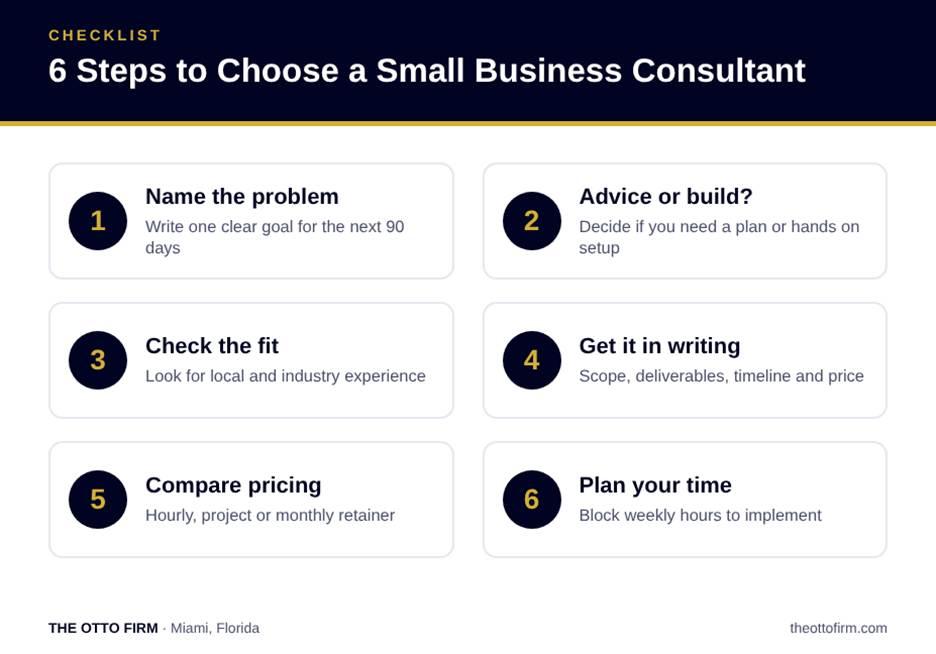
To choose a small business consultant in Miami, work through these steps in order:
1. Name the one problem you need solved and your business stage.
2. Decide if you need advice only or hands on implementation.
3. Check local knowledge and experience with businesses like yours.
4. Get a written scope with deliverables, a timeline and a price.
5. Plan time each week to put the work into action.
What Does a Small Business Consultant Do?
A small business consultant is an outside expert who helps you plan, fix or build parts of your business. The work usually falls into a few areas:
• Strategy: your business model, positioning, pricing and goals.
• Operations: workflows and SOPs. SOPs (standard operating procedures) are the written steps your team follows for routine tasks.
• Sales and marketing: lead generation, a sales pipeline and follow up.
• Financial setup: bookkeeping, invoicing and cash flow tracking.
• Systems: a CRM (customer relationship management software), email, payments and client documents.
Some consultants go deep in one area. Others coordinate several areas at once. Neither is better by default. The right fit depends on what is holding your business back right now.
Consultant, Coach or Accountant?
These roles overlap, so owners often hire the wrong one. Use this table to sort them out.
Role | Main focus | Best when you need |
Business consultant | Your business: strategy, systems and processes | A specific problem solved or a system built |
Business coach | You as the owner: habits, decisions and accountability | Support to grow as a leader over time |
CPA or tax professional | Tax filings, compliance and financial statements | Tax advice and accurate financial reports |
Attorney | Contracts, entity choice and legal risk | Legal advice for your situation |
A good consultant knows where the job ends. Expect them to refer tax and legal questions to licensed professionals.
Are You Ready to Hire a Small Business Consultant in Miami?
Your stage shapes the help you need. Find yourself below.
You Have an Idea but No Business Yet
You need clarity before you spend money on a logo or website. Look for help with your business model, target customer, pricing and a simple launch plan. A common mistake here is buying tools before you know what you sell and to whom.
You Formed a Business but Have No Systems
You have an LLC and maybe an EIN. Still, leads live in your inbox and invoices live in your head. You need infrastructure: a CRM, a payment process, client documents and basic bookkeeping. Many new owners stall here because the work feels dull and is easy to delay.
Your Business Runs but Cannot Scale
Sales come in, yet everything depends on you. You need documented processes, a predictable sales pipeline and clear numbers. A consultant can help you hand off tasks without losing quality.
How to Choose the Right Consultant in 6 Steps
Use these steps to compare your options on equal terms.
Step 1: Name the Problem and the Goal
Write one sentence that describes your problem. For example: “We get leads but lose them because nobody follows up.” Then add the result you want within 90 days.
Why it matters: A clear problem lets you compare consultants fairly. It also keeps the project from drifting.
Mistake to avoid: Asking for “help growing the business” with no target. Vague goals lead to vague work.
Step 2: Decide Between Advice and Implementation
Ask yourself what you really want. Is it a plan you will carry out yourself? Or is it a partner who builds the systems with you?
Why it matters: Many owners already know what to do. They lack the time or skills to set it up. A strategy document will not close that gap.
Mistake to avoid: Paying for a long report when you really needed a working CRM, signed contracts and an invoicing process.
Step 3: Check Local and Industry Experience
Ask about past work with businesses of your size and type. A Miami consultant should understand the local market and Florida filing rules.
Why it matters: Industry experience shortens the learning curve. A consultant who knows real estate or home services will spot common gaps faster.
Mistake to avoid: Hiring based on social media popularity alone. Ask for examples of similar work and references you can call.
Step 4: Get a Written Scope
Request a proposal that lists deliverables, a timeline, who does what and the total cost.
Why it matters: A written scope protects both sides. You know exactly what you will receive and when.
Mistake to avoid: Starting on a handshake. If a consultant avoids putting terms in writing, keep looking.
Step 5: Compare Pricing Models, Not Just Prices
Consultants usually charge by the hour, by the project or through a monthly retainer. Rates vary widely based on experience, scope and how much hands on work is included. Ask what each price covers.
Why it matters: A low hourly rate can cost more if the project has no end date. A fixed project fee makes budgeting easier.
Mistake to avoid: Comparing a cheap advice package with a full build as if they were the same product.
Step 6: Plan Your Own Time
Block a few hours each week for meetings, decisions and training.
Why it matters: Even the best consultant cannot build your business without your input. Delays on your side stretch the timeline.
Mistake to avoid: Hiring help during your busiest season and then missing every check in.
Questions to Ask Before You Sign
• What does a typical project with a business like mine look like?
• What will I have at the end that I do not have now?
• How long will it take and what do you need from me?
• Will you set up the tools or only recommend them?
• Who owns the accounts, documents and data you create?
• How will we measure progress?
• What happens if I need more time or want to stop?
Red Flags to Watch For
• Guarantees of funding, loan approval or a specific revenue number.
• Pressure to sign the same day.
• No written scope or contract.
• Tax or legal advice from someone who is not licensed to give it.
• Software accounts set up in the consultant’s name instead of yours.
• Fees for simple government filings without telling you that you can do them yourself.
Free and Low Cost Help in Miami
You do not always need a paid consultant first. The SBA local assistance finder lists free counseling partners near you. These include Small Business Development Centers and SCORE mentors.
Miami-Dade also has a Florida SBDC center at FIU. Check each program’s eligibility rules before you apply. Free programs work well for advice and training. A paid consultant often makes sense when you need someone to build and install systems with you on a set timeline.
Florida Basics a Good Consultant Should Cover
Whoever you hire, make sure these basics are not missed:
• An EIN: This is your federal tax ID number. The IRS lets you apply online for free.
• Your Sunbiz annual report: Florida LLCs and corporations file this report every year. According to the Florida Division of Corporations, it is due by May 1. Businesses other than nonprofit corporations pay a $400 late fee after that date (as of 2026).
• A separate business bank account: This keeps personal and business money apart.
• Bookkeeping from day one: Record income and expenses every month.
• Clear client contracts: Put your scope, payment terms and policies in writing.
Tax and legal rules change over time. Confirm the details with a licensed CPA, tax professional or attorney for your situation.
Example: What a Full Business Build Looks Like
Here is a simple example. It is an illustration, not a real client.
Maria runs a new home cleaning company in Kendall. She formed an LLC and has a few regular customers. Leads arrive by text message. She tracks payments in a notebook. A structured build would close her gaps in this order:
1. Foundation: Define her services, ideal customer, pricing and 12 month goals.
2. Infrastructure: Set up a CRM, online payments, a service agreement and simple bookkeeping.
3. Marketing and sales: Create a lead form, a follow up sequence and a quote template.
4. Launch and growth: Track bookings and revenue each month, then adjust.
The Otto Firm follows this same order in its 120 day Business Build. Each phase builds on the last, so the business is ready to run instead of just planned.
Notice the order. Marketing comes after the systems that capture and serve new customers. If you spend on ads first, you may pay for leads you cannot handle.
Frequently Asked Questions
How much does a small business consultant in Miami cost?
Costs vary widely by experience, scope and pricing model. Hourly, project and monthly retainer fees are all common. Ask for a written quote that lists exactly what is included.
What is the difference between a consultant and a business coach?
A consultant works on your business, such as strategy, systems and processes. A coach works with you as the owner on habits, decisions and accountability. Some providers offer both.
Is there free small business help in Miami?
Yes. SBA resource partners such as SCORE and the Florida SBDC network offer free or low cost counseling. Check each program’s eligibility rules and services before you apply.
When should I hire a small business consultant?
Hire one when a specific problem keeps costing you time or money and you lack the time or skills to fix it. Common triggers include a launch, stalled sales or growth past your own capacity.
Can a consultant guarantee business funding?
No honest consultant can guarantee funding. Lenders decide based on factors such as credit, cash flow and documents. A consultant can help you prepare, but approval is never certain.
Final Thoughts
The best consultant for you solves your specific problem at your current stage. They also put deliverables, timelines and costs in writing. Start with the problem, check the fit and protect your time to implement.
Not sure where your gaps are? Take the free Business Readiness Assessment to see what your business needs next. You can also book a free strategy call on theottofirm.com to talk through your results.
About the Author Aldian Otto is the founder of The Otto Firm, a business consulting firm in Miami, Florida. He helps entrepreneurs build, fund and launch businesses that are ready to run, with strategy, systems and support in one structured process. |