
How to Write a Business Plan for a Startup
Starting a new company requires clear direction, active systems and financial clarity. When you know how to write a business plan for a startup, you turn a simple idea into an organized roadmap that guides your decisions and attracts capital.
Many founders feel overwhelmed by vague templates and complex financial models. This step by step guide breaks down every section of a practical business plan, helping you build strong operations, reach target clients and run a profitable business from day one.
Choosing Between a Lean Plan and a Traditional Business Plan
Before writing a single paragraph, decide which business plan format fits your current goals. Entrepreneurs who need bank financing or equity investors typically write a comprehensive traditional plan. Startup founders who want to validate an idea quickly often start with a simple business plan template before building out a detailed document.
A traditional plan covers every detail of your business model, leadership team, operational systems and financial forecasts over three to five years. Government lenders, traditional banks and institutional venture capital groups usually require this standard format. On the other hand, a lean business plan covers high level strategy, core offer positioning and immediate cash flow targets in just two or three pages.
| Plan Type | Best For | Primary Focus | Typical Length |
|---|---|---|---|
| Traditional Business Plan | Bank loans, SBA loans, formal investors | Detailed market research, SOPs and 3 to 5 year financial statements | 15 to 30 pages |
| Lean Business Plan | Quick launch, internal testing, fast validation | Value proposition, core offer, direct channel costs and key metrics | 1 to 3 pages |
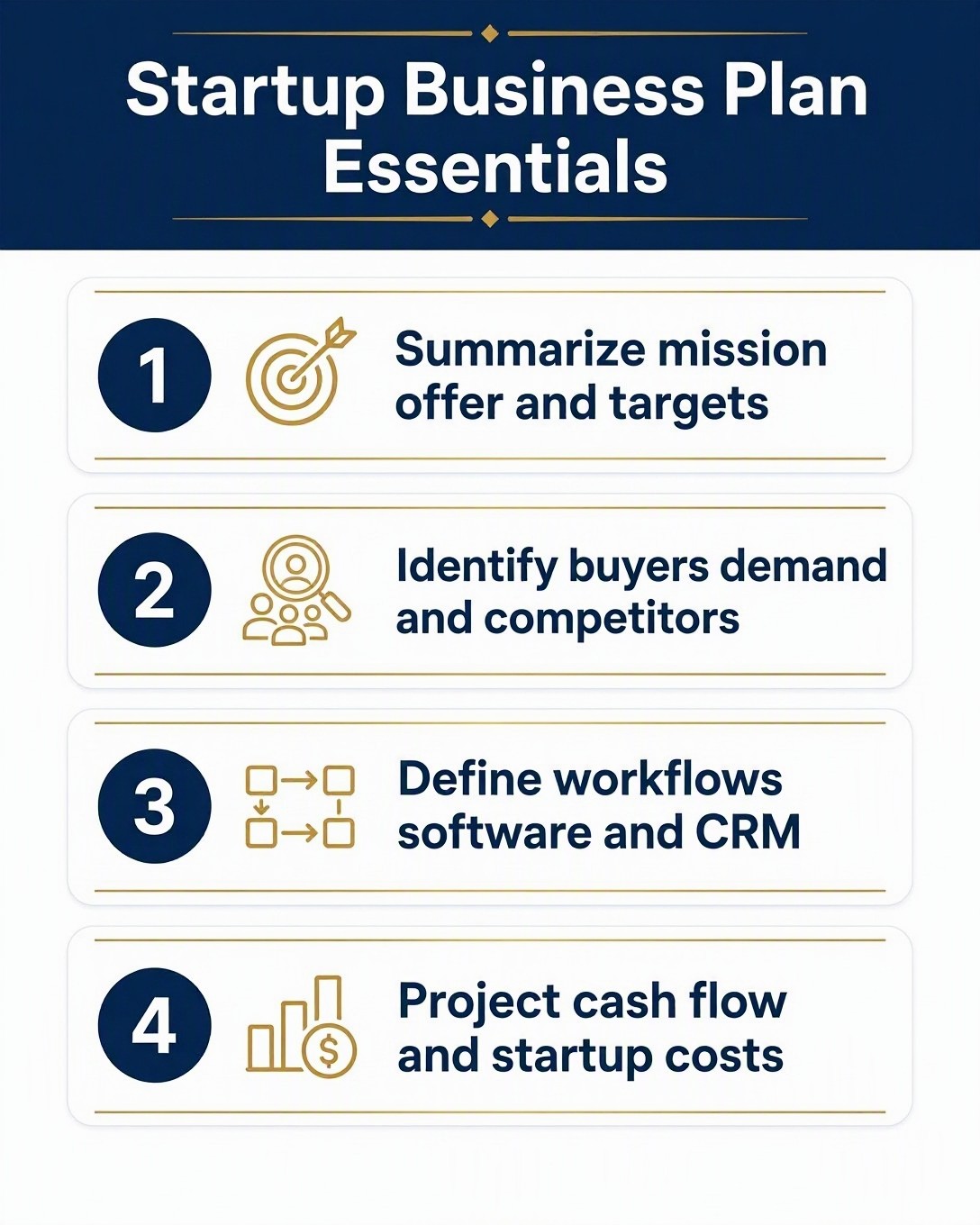
How to Write a Business Plan Step by Step
Writing a useful business plan means focusing on operational facts rather than unproven assumptions. Follow these practical steps to build a complete document that serves your business daily.
1. Draft Your Executive Summary
Your executive summary gives readers a high level snapshot of your company. Although this section appears at the beginning of your plan, write it last after finalizing your numbers and strategy. Briefly explain your mission, target market, core offer, leadership background and key financial goals.
If you plan to seek external funding, state the exact amount of capital you need and how you will use those funds. Keep this section clear and energetic. Readers should understand your entire business model in under two minutes.
2. Write a Detailed Company Description
Your company description explains who you are, what problem you solve and why your approach works better than current alternatives. Outline your legal entity structure, such as a single member LLC, S Corporation or partnership. If you have already registered your entity with state offices like the Florida Division of Corporations, note your active status and jurisdiction.
Explain your brand positioning, core services and competitive advantage. Describe the specific pain points your customers experience and how your offer directly solves them. Include details about your official tax setup, such as your Employer Identification Number obtained from the IRS.
3. Conduct Market Analysis and Competitive Analysis
A thorough market analysis proves that real demand exists for your product or service. Define your target audience using demographic factors like age, income level and location, along with behavioral details like purchasing habits and core challenges. Avoid broad claims such as target market includes everyone. Focus on a specific customer profile that you can reach cost effectively.
Next, perform a competitive analysis. Identify your primary direct competitors and secondary indirect competitors. Analyze their strengths, pricing strategy, market share and operational weaknesses. Create a simple matrix comparing your features, client experience and pricing against theirs to highlight your distinct market position.
4. Map Out Your Operations Plan and Infrastructure
An operations plan details how your business functions every single day. Many startup plans fail because they focus entirely on sales while ignoring back office execution. Detail your physical or digital location, necessary equipment, software stack and key vendors.
Outline your internal workflow and document essential standard operating procedures. Mention how you will manage customer service, handle sales pipelines using a modern CRM, draft service contracts and track daily work. Demonstrating strong operational infrastructure reassures investors that your business can deliver service smoothly as demand increases.
5. Create Your Marketing Plan and Sales Strategy
Your marketing plan details how you will attract potential clients, while your sales strategy explains how you will convert leads into paying customers. Define your pricing strategy clearly, including flat rates, retainer models or tier based pricing structures. Ensure your pricing covers labor, overhead and desired profit margins.
List your active lead generation channels, such as local networking, direct email outreach, referral partnerships, targeted search advertising or social media campaigns. Outline your conversion process step by step, from the initial discovery call to proposal delivery and final contract sign off. Clear pipeline stages prevent revenue leaks and establish consistent cash flow.
6. Build Financial Projections and Funding Request
Your financial section translates your strategy into numbers. Include three core financial statements: a cash flow statement, an income statement and a balance sheet. For new startups, provide monthly financial projections for the first twelve months and annual projections for years two through five.
If you are applying for commercial financing, review standard loan guidelines provided by the U.S. Small Business Administration or follow a standard sba business plan template. Clearly list your startup costs, break even point and projected revenue milestones. If you need capital, write a formal funding request outlining the loan or investment amount, terms and direct allocation of capital across equipment, staffing and marketing.
Startup Business Plan Example in Action
To see how these principles work together, consider this startup business plan example based on a realistic scenario for a Florida business consulting agency.
Example Scenario: Apex Advisory Services is a Miami based consulting startup offering operational workflow design and CRM integration for regional logistics firms. The founder needs 50,000 dollars in initial debt funding to launch operations, purchase software licenses and cover working capital for three months.
- Executive Summary Target: Secure a 50,000 dollar bank loan to generate 180,000 dollars in top line revenue in Year 1 by serving 12 mid sized logistics clients.
- Market Position: Specializes exclusively in logistics operational bottlenecks, offering custom software setups that larger generic management agencies ignore.
- Operations Stack: Uses cloud based client portals, automated invoicing software, documented SOPs and digital contract sign off to keep overhead below 15 percent.
- Financial Target: Reaches break even status by Month 4 with three active monthly retainer clients paying 4,500 dollars each.
By keeping the plan grounded in realistic pricing and operational efficiency, the owner presents a low risk scenario to commercial lenders while creating a clear daily execution model.
Red Flags to Avoid in Your Startup Business Plan
Lenders, investors and experienced consultants look for realistic assumptions. Avoid these common mistakes when drafting your document:
- Unrealistic Revenue Growth: Projecting hockey stick growth without explaining the direct marketing budget or sales capacity needed to achieve it.
- Ignoring Operating Overhead: Forgetting realistic expenses like insurance, software subscriptions, merchant processing fees, legal expenses and taxes.
- Vague Target Audiences: Defining your market too broadly instead of focusing on a specific target profile.
- No Clear Exit or Repayment Strategy: Failing to show lenders exactly how cash flow will cover principal and interest payments.
Always confirm tax, legal and financing details with a licensed CPA, tax professional or attorney for your specific situation.
Turn Your Business Plan into an Operational System
Writing a solid business plan is an important first step, but a plan sitting in a digital folder will not build a profitable enterprise. To succeed, you must translate your document into real day to day business infrastructure, organized sales pipelines and reliable backend management.
At The Otto Firm, we help entrepreneurs bridge the gap between planning and real execution. Through our 120-Day Business Build, we take you from concept to launch across four structured phases: Foundation, Infrastructure, Marketing and Sales, and Launch and Growth. We build your operational workflows, set up your CRM, structure your client portal, streamline bookkeeping systems and refine sales proposals so your enterprise operates smoothly from day one.
Frequently Asked Questions
How long should a startup business plan be?
A standard startup business plan ranges from 15 to 25 pages. A lean plan used for internal operational planning can be as short as 2 to 5 pages.
Do I need a business plan if I am self funding my startup?
Yes. A business plan clarifies your pricing, defines operational software needs, tracks cash flow targets and prevents costly errors even if you do not need external investor capital.
What is the most important section of a business plan?
The executive summary is the most critical section for readers, while the financial projections and operations plan are most vital for ongoing internal execution and risk control.
How often should I update my small business plan?
Review your plan quarterly to compare projected numbers against actual revenue and costs. Update the core strategy annually or whenever your business model changes significantly.
Build Your Business Foundation Today
Learning how to write a business plan for a startup gives you total clarity over your finances, marketing channels and everyday operations. Take time to validate your pricing, structure your workflows and gather honest market research before launching.
If you are ready to turn your ideas into a fully operational business with practical systems, evaluate your progress with our free Business Readiness Assessment today or explore our dedicated business consulting services to start building your foundation.