
How to Start a Small Business in 2026: A 10-Step Guide
You have an idea, some savings and a lot of questions. Maybe you are not sure if you need an LLC, how to get an EIN or how to find your first customers. Learning how to start a small business can feel confusing because most advice covers only one piece of the puzzle.
This guide walks you through the full process in 10 clear steps. You will learn what to do first, what it costs in Florida and how to set up the systems that keep a new business running. By the end, you will have a simple plan you can start this week.
Quick Answer
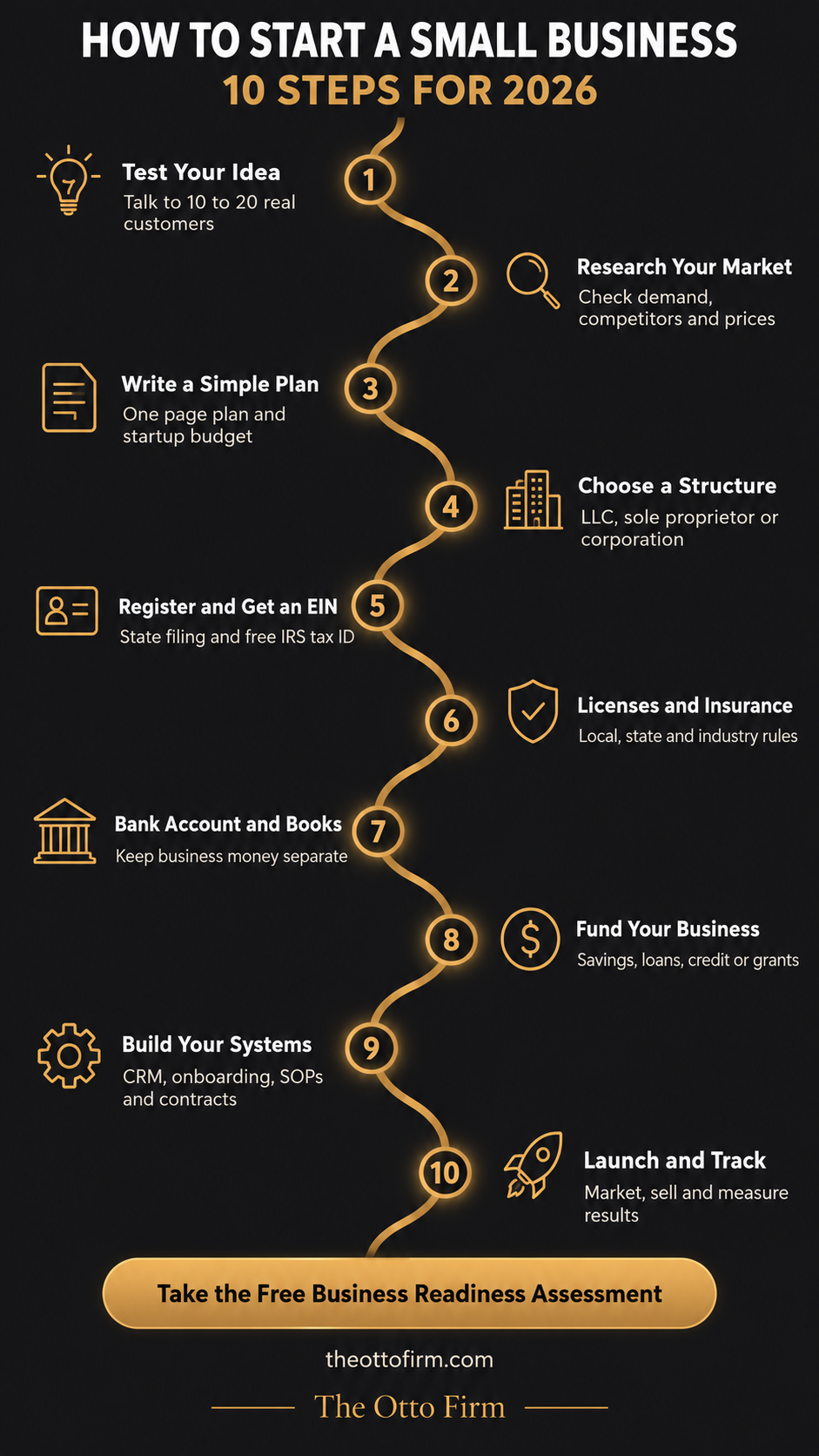
To start a small business in 2026, follow these steps in order:
Test your business idea.
Research your market and competitors.
Write a simple business plan and budget.
Choose a business structure.
Name and register your business, then get an EIN.
Get the licenses, permits and insurance you need.
Open a business bank account and set up bookkeeping.
Fund your business.
Build your business systems.
Market, launch and track your results.
How to Start a Small Business: The 10 Steps
The steps below follow the order most new owners need. Some can run at the same time, but skipping one usually costs you money later.
Step 1: Test Your Business Idea
A good idea solves a real problem for people who will pay to fix it. Before you spend money, write one sentence that answers three questions: who you serve, what problem you solve and why they would choose you.
Then talk to 10 to 20 people who fit your target customer. Ask about the problem, not your idea. Find out how they solve it today and what that costs them.
Why it matters: Talking to customers early is the cheapest way to avoid building something nobody wants.
Common mistake: Asking friends and family if they "like" your idea. They will be kind. Strangers in your market will be honest.
Step 2: Research Your Market and Competitors
Market research shows you if enough people want what you sell. Look for three things:
Demand: Are people already searching for or buying this service?
Competition: Who sells it now, at what price and with what reviews?
Gaps: What do customers complain about that you could do better?
Check competitor websites, Google reviews and social media pages. Note their prices, offers and how they get leads. The SBA business guide also lists free tools for market research and competitive analysis.
Common mistake: Thinking you have "no competition." If nobody sells it, you may not have a market yet.
Step 3: Write a Simple Business Plan and Budget
You do not need a 40 page plan. A one or two page plan works well for most small businesses. Cover these points:
What you sell and to whom
Your pricing and how you make a profit
How you will find customers
Your startup costs and monthly expenses
Your goals for the first 90 days and the first year
Next, list your startup costs. Include filing fees, equipment, software, insurance, a website and marketing. Then add at least three to six months of operating expenses. This gives you a safety cushion while sales grow.
Why it matters: Pricing and cash flow (the money moving in and out of your business) decide if you survive the first year. A plan forces you to check the math early.
Step 4: Choose a Business Structure
Your business structure affects your taxes, your paperwork and your personal liability. Liability means how much of your personal money is at risk if the business owes money or gets sued.
Structure | Best for | Personal liability protection | Paperwork |
|---|---|---|---|
Sole proprietorship | Testing an idea alone with low risk | No | Very low |
General partnership | Two or more owners with low risk | No | Low |
LLC (limited liability company) | Most small service businesses | Yes, in most cases | Moderate |
Corporation (C corp or S corp election) | Businesses planning to raise investment or scale fast | Yes | High |
Many small business owners choose an LLC because it separates personal and business assets with less paperwork than a corporation. However, the right choice depends on your income, your goals and your risk.
Tax and legal note: confirm your structure and any S corp election with a licensed CPA or attorney for your situation.
Step 5: Name and Register Your Business, Then Get an EIN
Pick a name. Make sure it is available in your state, as a website domain and on social media. A clear name that says what you do helps customers find you.
Register with your state. In Florida, you form an LLC with the Division of Corporations at Sunbiz. According to the Florida Division of Corporations fee schedule, a new LLC costs $125 as of 2026 ($100 filing fee plus a $25 registered agent fee). Florida LLCs also file an annual report, which costs $138.75 and becomes $538.75 if it arrives after May 1. Fees can change, so check the current schedule before you file.
Get an EIN. An Employer Identification Number (EIN) is your business tax ID. You need it to open a business bank account, hire staff and file business taxes. The IRS says you never have to pay for an EIN. You can apply online and, if approved, receive it right away. Register your LLC with the state first, then apply.
Good news on BOI reports: In 2025, FinCEN removed the beneficial ownership information (BOI) reporting requirement for U.S. companies, and a final rule in 2026 made that exemption permanent. You can check the latest status on the FinCEN BOI page.
Common mistake: Paying a website to get an EIN for you. The IRS application is free.
Step 6: Get Licenses, Permits and Insurance
Most businesses need at least one license or permit. Requirements depend on your industry and location. Check three levels:
Federal: Only some industries need a federal license, such as transportation, alcohol or firearms.
State: Many professions need a state license, such as real estate, contractors and cosmetology.
Local: Your city or county may require a local business tax receipt, zoning approval or a home business permit.
The SBA guide on licenses and permits is a good place to start. Call your city or county office if you are unsure.
Next, protect your business with insurance. General liability insurance is common for most service businesses. Depending on your work, you may also need professional liability, commercial auto or workers' compensation coverage.
Common mistake: Opening without the right local license. Fines and back fees can cost more than the license itself.
Step 7: Open a Business Bank Account and Set Up Bookkeeping
Keep your business money separate from your personal money from day one. Open a business checking account using your EIN and formation documents.
Then set up bookkeeping. Bookkeeping means recording every dollar that comes in and goes out. Choose simple accounting software and connect it to your business account. Set up a clear system for:
Sending invoices and taking payments
Saving receipts
Tracking revenue and expenses each month
Setting money aside for taxes
Why it matters: Clean books make tax time easier and show you which services actually make a profit. They also help when you apply for funding.
Common mistake: Paying business costs from a personal card. Mixing funds makes taxes harder and can weaken the liability protection your LLC gives you.
Step 8: Fund Your Business
Add up your startup costs from Step 3. Then choose how you will cover them. Common options include:
Personal savings: You keep full control, but you take on the risk.
Friends and family: Put every agreement in writing.
SBA backed loans and microloans: Lenders offer these with SBA support, often with longer terms.
Business credit cards and lines of credit: Useful for short term costs if you pay them off.
Grants: Helpful but competitive, and usually for specific groups or industries.
Start building business credit early. Use your EIN, keep your business details consistent everywhere and pay every bill on time.
Financing note: loan terms and approval depend on your credit, revenue and lender. Review offers with a qualified financial professional before you sign.
Step 9: Build Your Business Systems
This is the step most guides skip, and it is where many new businesses struggle. Registering a business does not make it ready to run. Systems do.
Set up these core systems before you launch:
CRM (customer relationship management): One place to store leads, track follow-ups and see your sales pipeline.
Client onboarding: A clear process for welcome emails, contracts and first meetings.
SOPs (standard operating procedures): Simple written steps for tasks you repeat, so quality stays the same as you grow.
Contracts and documents: Service agreements, proposals and policies that protect you and your clients.
Payments: Online invoices and payment links so clients can pay you fast.
Example (not a real client): Maria opens a bookkeeping service in Miami. She registers her LLC and gets her EIN in one week. But without a CRM or onboarding process, leads slip through the cracks. After she sets up automatic follow-up emails and a standard welcome packet, she can handle more clients without working longer hours.
At The Otto Firm, we build these systems for you in our 120-Day Business Build, so your business runs as one connected system instead of scattered tools.
Step 10: Market, Launch and Track Your Results
Now you are ready to get customers. Start with a few channels and do them well:
Brand basics: A clear logo, colors and a simple message about who you help.
Website: One page that explains your offer and makes it easy to contact you or book a call.
Google Business Profile: Free and important for local search.
Social media: Pick one or two platforms where your customers spend time and post consistently.
Referrals: Ask happy clients and your network to refer people to you.
Launch with a clear offer and a simple goal, such as your first 10 clients. Then track a few numbers each week: leads, sales calls, new clients, revenue and expenses. These numbers show you what works so you can do more of it.
Startup Checklist
Use this checklist to track your progress:
Idea tested with 10 to 20 real customers
Competitors and prices researched
One page business plan and budget written
Business structure chosen
Name checked and business registered with the state
EIN received from the IRS
Licenses, permits and insurance in place
Business bank account opened
Bookkeeping and invoicing set up
Funding plan ready
CRM, onboarding, SOPs and contracts set up
Website, Google Business Profile and launch offer ready
Red Flags to Avoid When Starting a Business
Watch for these common problems:
Building before validating: Spending months on a logo and website before anyone agrees to buy.
Underpricing: Charging too little to cover your costs, taxes and time.
No cash cushion: Starting with no money set aside for slow months.
Piece by piece setup: Using random tools that do not connect, so leads and payments get lost.
Doing everything alone: Guessing on legal, tax and system decisions instead of getting expert help.
Frequently Asked Questions
How much does it cost to start a small business?
It depends on your industry. A simple service business can start with a few hundred to a few thousand dollars. Businesses that need inventory, equipment or a location usually cost much more.
Do I need an LLC to start a business?
No. You can start as a sole proprietor. However, many owners form an LLC to separate personal and business assets. Ask a CPA or attorney which structure fits your situation.
How long does it take to start a small business?
You can register a business and get an EIN in a few days. Building the systems, brand and marketing to run it well often takes a few months.
Can I start a business while working a full time job?
Yes. Many people start on nights and weekends. Check your employment agreement first, and plan when you will move to the business full time.
What is the first step to starting a small business?
Test your idea with real customers. Make sure people have the problem you solve and will pay for your solution before you spend money on setup.
Final Thoughts
Starting a small business is not one big leap. It is a series of clear steps done in the right order. Validate your idea, set up your legal and financial basics, then build the systems that let your business run without chaos. Pick one step from this guide and finish it this week.
Not Sure Where Your Business Stands?
Take our free Business Readiness Assessment. It shows you where you are now, what is missing and what to fix first. Prefer to talk it through? Book a free strategy call with our team.
Note: This article is for general information only. It is not legal, tax or financial advice. Confirm the details for your situation with a licensed CPA, tax professional or attorney.