How to Start a Business Without Money: 9 Practical Steps
Wondering how to start a business without money? You are not alone. Many people have the skills and drive to work for themselves but no savings to invest. The idea of big startup costs stops them before they begin.
Here is the truth: you can start many businesses with very little money if you choose the right model and spend carefully. This guide shows you which businesses need the least cash, the 9 steps to start lean and the mistakes that drain money you do not have.
Quick Answer
To start a business without money, choose a service business that uses skills you already have. Then follow these basics:
Pick a low cost business model, such as a service based on your skills.
Use free tools for your website, email and marketing.
Get your first paying customer before you spend money.
Reinvest early profits to grow step by step.
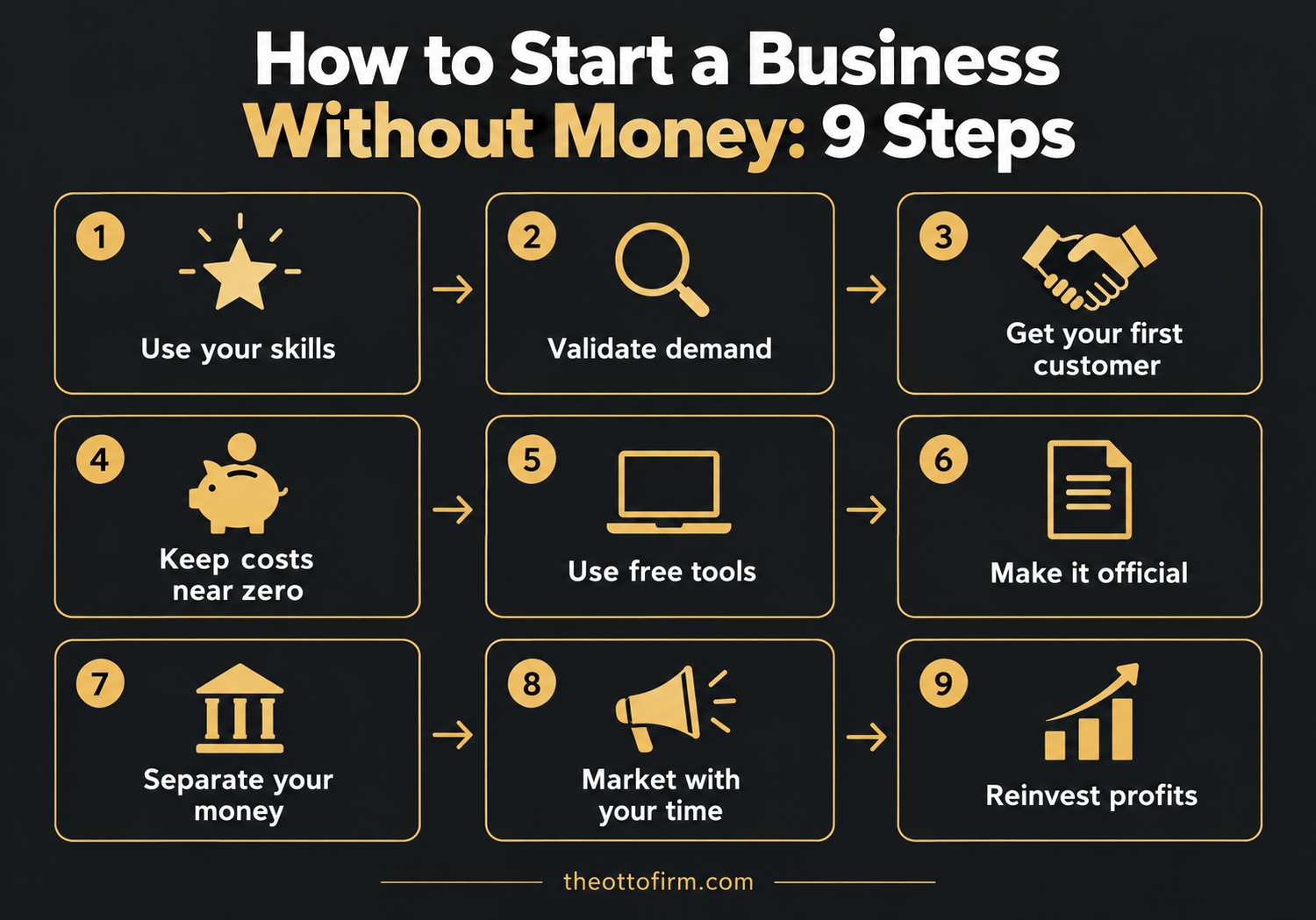
Infographic showing 9 steps for how to start a business without money
What Starting a Business Without Money Really Means
Almost no business costs exactly zero. You will likely pay small amounts for things like state registration fees, a domain name or basic insurance. So "without money" usually means starting with very little money and no large upfront investment.
The key is choosing a business where your main asset is your skill and time, not equipment, inventory or a physical location. This approach is often called bootstrapping, which means building a business using your own resources and the revenue it earns, instead of outside money.
Businesses that usually need the least money to start
Business type | Why it is low cost | Examples |
|---|---|---|
Skill based services | You sell your time and knowledge | Bookkeeping support, consulting, tutoring, writing |
Digital services | Needs only a laptop and internet | Social media management, web design, virtual assistance |
Home and local services | Uses basic tools you may already own | Cleaning, organizing, pet sitting, handyman work |
Reselling and freelance platforms | No inventory until a customer orders | Print on demand, freelance marketplaces |
Businesses that usually need more money include restaurants, retail stores, manufacturing and anything that needs large inventory, equipment or a commercial lease. Those can still be good businesses, but they are harder to start with no savings.
How to Start a Business Without Money in 9 Steps
Step 1: Start with skills you already have
List what you are good at from work, school and life. Your experience is your biggest free asset. If you can already do the work, you do not need to pay for training or equipment to start.
Why it matters: A skill based business can earn money from day one with almost no setup cost.
Mistake to avoid: Choosing a business you would need to learn from scratch. Learning costs time and often money.
Step 2: Validate demand for free
Before you spend anything, confirm people will pay. Talk to potential customers, join online groups where they ask questions and study what competitors charge. The SBA's guide to market research and competitive analysis explains simple ways to do this.
Why it matters: Testing first means you never spend money on an idea nobody wants.
Mistake to avoid: Asking friends if they "would buy." Ask strangers what they already pay to solve the problem.
Step 3: Get your first customer before you spend
Offer your service to a few people directly. Use your personal network, past coworkers and local groups. Ask for a small paid project or a deposit up front. This is often called pre-selling, which means getting paid before you fully build the offer.
Why it matters: Early revenue pays for your next costs, so you do not need savings.
Mistake to avoid: Working for free for too long. One or two free samples can help, but paying customers prove your business is real.
Step 4: Keep your startup costs close to zero
Only buy what you need to deliver the work. Use the laptop and phone you already have. Skip the office, fancy logo and paid ads at first. Write down every cost so you always know where your money goes.
Why it matters: Every dollar you do not spend is a dollar you do not need to find.
Mistake to avoid: Buying tools "just in case." Pay for a tool only when a real need appears.
Step 5: Use free tools to look professional
Many useful business tools have free plans. You can use free versions of email, document, design, scheduling and CRM software. A CRM (customer relationship management system) keeps track of every lead and client so nothing gets missed. A free Google Business Profile helps local customers find you.
Why it matters: Free tools let you look and work like an established business without monthly bills.
Mistake to avoid: Signing up for many free trials that turn into paid plans. Track trial end dates.
Step 6: Make your business official the low cost way
Check what registration and licenses your business needs in your state and local area. Fees vary by state and by business type, and they can change, so check your state's official website for current costs. You can apply for an EIN with the IRS at no cost. An EIN (Employer Identification Number) is a tax ID for your business. Confirm the right structure and tax setup with a licensed CPA or attorney for your situation.
Why it matters: Being official protects you and makes customers trust you.
Mistake to avoid: Paying a third party website for an EIN. The IRS issues it for free.
Step 7: Separate your money from day one
Open a business bank account, and compare options since many banks offer accounts with low or no monthly fees for small businesses. Record every sale and expense, even if it is just in a simple spreadsheet. This record keeping is called bookkeeping.
Why it matters: Clear records show you whether you are actually making money and make tax time easier.
Mistake to avoid: Mixing business and personal spending. It hides your real profit.
Step 8: Market with time instead of money
When you have no budget, your time becomes your marketing budget. Post helpful content on social media, comment on posts in your industry, ask happy customers for reviews and referrals and follow up fast with every inquiry.
Why it matters: Free marketing builds trust slowly but steadily, and referrals are often your best customers.
Mistake to avoid: Posting without a clear message. Tell people exactly who you help and how.
Step 9: Reinvest your first profits wisely
As money comes in, put part of it back into the business. Spend first on what saves you time or brings in more customers, such as a better website, a paid tool or simple automation.
If you later decide you need outside capital, the U.S. Small Business Administration explains options such as its microloan program for small businesses. Terms and eligibility change, so check current details and speak with a financial professional before borrowing.
Why it matters: Growing from your own profits keeps you in control and avoids debt.
Mistake to avoid: Spending your first profits on things that look good but do not grow revenue.
Build the System Early, Even on a Small Budget
Starting without money works best when you treat it like a real business from the start. That means a clear plan, simple systems, organized finances and a steady way to win customers. The Otto Firm helps owners put these foundations in place, so a small start can grow into a business that is ready to run.
Free vs Paid: What to Spend On First
Need | Start free with | Pay for it when |
|---|---|---|
Website | A free website builder plan or a simple landing page | Customers expect a custom domain and more pages |
A free email account | You want an email on your own business domain | |
CRM | A CRM with a free plan or a spreadsheet | You have more leads than you can track by hand |
Design | Free design tools and templates | You need a full brand identity |
Marketing | Social media, referrals and reviews | You know which channel brings customers and want to scale it |
Bookkeeping | A spreadsheet or free accounting software | Your transactions grow or you hire staff |
Example: Starting a Virtual Assistant Business With Little Money
This is a made up example to show the process, not a real client.
Aisha worked as an administrative assistant for five years. She wanted her own business but had very little savings. She listed her skills: scheduling, email management and organizing documents.
She messaged 20 small business owners she knew and found three who were overwhelmed by admin work. Two agreed to a paid trial month. With that first income, she registered her business, opened a business bank account and set up a free CRM to track new leads.
Aisha used social media posts and client referrals to find her next customers. She only paid for new tools once her monthly income could cover them.
Red Flags to Watch For
"Business opportunities" that ask you to pay first. Many schemes promise easy income but require upfront fees or buying inventory.
Putting business costs on high interest credit cards. Debt can grow faster than your revenue.
No paying customer after weeks of work. Revisit your offer or your target market.
Skipping licenses to save money. Fines can cost far more than the fee.
Doing everything for free to "build a portfolio." Set a clear limit, then start charging.
Frequently Asked Questions
Can you really start a business with no money?
You can start many service businesses with very little money. Most still have small costs, such as state registration fees. The key is using your skills and getting paid before you spend.
What business can I start with no money?
Skill based and digital services are usually the cheapest to start. Examples include bookkeeping support, virtual assistance, tutoring, cleaning, writing and social media management.
How do I get my first customer with no budget?
Start with your personal network, past coworkers and online groups where your customers ask questions. Offer a clear service, ask for referrals and follow up quickly with everyone who shows interest.
Do I need to register my business if I have no money?
In most cases, yes. Registration and license rules depend on your state, local area and industry. Check your state's official website and confirm details with a CPA or attorney.
Should I borrow money to start a business?
It depends on your business, your plan and your ability to repay. Many owners start small first and borrow only once they have steady revenue. Speak with a financial professional before taking on debt.
Conclusion
A lack of money does not have to stop you from starting a business. Choose a model built on your skills, prove demand before you spend and grow from your own profits. Small, careful steps lead to a business you control.
Your next step: write down three skills you could sell this month, then reach out to five people who might need them.
Want to know what your business needs to grow? Take the free Business Readiness Assessment on theottofirm.com to see where you stand. You can also book a free strategy call to plan your next steps.