How to Start a Business in Miami: 9 Steps to Launch in 2026
Miami is full of people with a business idea. Fewer of them turn that idea into a company that is legal, funded and ready to serve customers. If you want to know how to start a business in Miami the right way, the path is clear once you see it laid out in order.
The tricky part is that Miami has three layers of rules: state, county and city. Miss one and you can face fines, delays or a forced pause right when you want to open. This guide walks you through each step in plain English so you can launch with confidence.
Quick Answer
To open a business in Miami, form your company with the state on Sunbiz, get a free EIN from the IRS, confirm zoning and get a Certificate of Use if your city requires one, then get both a city and a Miami-Dade County business tax receipt. Register for state taxes, open a business bank account and set up your yearly compliance calendar.
Why Miami Is a Strong Place to Build a Business
Miami gives you access to a large, diverse customer base, strong ties to Latin America and a steady flow of new residents. Florida also has no personal income tax, which means profits from most pass through businesses are not taxed again at the state level.
Those advantages come with real competition. Rent can be high, customers have many choices and local rules vary from one city to the next. The owners who do well usually start with a plan, a clean legal setup and systems that let them grow without chaos.
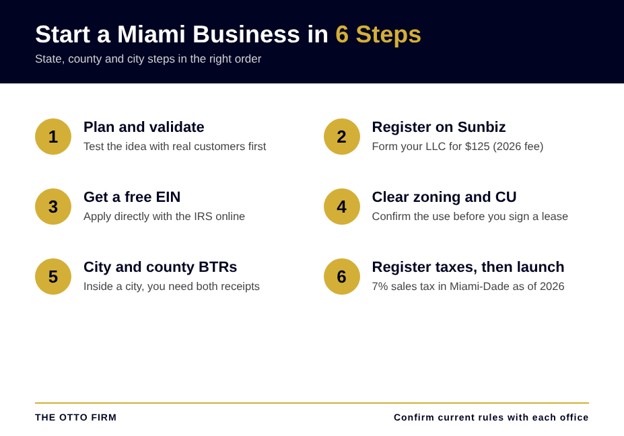
9 Steps to Start a Business in Miami
Step 1: Validate Your Idea and Write a Simple Plan
What to do: Talk to at least a handful of potential customers before you spend money. Write a short plan that covers who you serve, what problem you solve, how you will price, how you will reach customers and how much cash you need to reach your first months of revenue.
Why it matters: A plan forces you to test your numbers early. It is also the first thing a lender, investor or landlord will want to see.
Mistake to avoid: Signing a lease or buying equipment before you know people will pay. Commitments made too early are one of the most common reasons new businesses run out of cash.
Step 2: Choose Your Business Structure
What to do: Decide between a sole proprietorship, a limited liability company (LLC) or a corporation. Many small business owners in Miami choose an LLC because it offers liability protection with fewer formalities than a corporation.
Why it matters: Your structure affects personal liability, taxes, paperwork and how easily you can bring in partners or investors.
Mistake to avoid: Running as a sole proprietor by default without understanding that your personal assets stand behind every business debt. Talk with a CPA or attorney about which structure fits your goals.
Step 3: Register Your Business With the State
What to do: Search your name and file your formation documents with the Florida Division of Corporations (Sunbiz). As of 2026, forming an LLC costs $125 in state fees. If you plan to operate under a name that differs from your legal name, register a fictitious name (DBA) on Sunbiz as well. That filing is $50 as of 2026 and also requires a newspaper notice in your county.
Why it matters: State registration creates your legal business and gives you a document number you will need for banking, licenses and tax accounts.
Mistake to avoid: Assuming that an open name on Sunbiz means you own the brand. Check trademarks, domains and social handles too.
Step 4: Get an EIN From the IRS
What to do: Apply for a free Employer Identification Number on IRS.gov. Most owners can finish the online application in one session.
Why it matters: You need an EIN to open a business bank account, hire employees, file business tax returns and apply for business tax receipts.
Mistake to avoid: Paying a third party site for an EIN. The IRS issues it for free.
Step 5: Confirm Zoning and Get a Certificate of Use
What to do: Before you sign a lease, confirm that your type of business is allowed at the address. In the City of Miami, most businesses need a Certificate of Use (CU) before they can get a city business tax receipt. The City of Miami New Business Guide explains the order of steps and the online eStart tool. Other cities in Miami-Dade County, such as Miami Beach, Coral Gables and Doral, run their own zoning and CU processes.
Why it matters: A CU confirms your location can legally host your type of business. Some uses also need inspections before approval, which can take time.
Mistake to avoid: Signing a lease before zoning is confirmed. If the use is not allowed, you may be stuck paying rent on a space you cannot open. Home based businesses may also need approval, so check before you start.
Step 6: Get City and County Business Tax Receipts
What to do: Apply for a business tax receipt (BTR) from your city if you operate inside one. Then apply for a local business tax receipt from the Miami-Dade County Tax Collector. Businesses inside a city need both. Businesses in unincorporated areas deal with the county.
Why it matters: A BTR is the local permission to operate. County receipts run from October 1 through September 30, so you will renew every year. You must display your receipt where customers can see it.
Mistake to avoid: Getting the city receipt and forgetting the county one, or the other way around. You also need a separate receipt for each location and for each business type at the same location.
Step 7: Register for State Taxes and Licenses
What to do: If you sell taxable goods or services, register with the Florida Department of Revenue to collect sales tax. As of 2026, the combined rate in Miami-Dade County is 7%: the 6% state rate plus a 1% county surtax. If you hire employees, also register for reemployment tax. Some professions, such as contractors, cosmetologists and real estate agents, need a state license as well.
Why it matters: Sales tax you collect belongs to the state. Missing registrations or filings can bring penalties and interest that hurt your cash flow.
Mistake to avoid: Mixing sales tax money with operating cash and then coming up short when the return is due.
Step 8: Open a Business Bank Account and Set Up Bookkeeping
What to do: Open a business checking account with your formation documents and EIN. Connect it to bookkeeping software and track every expense from day one.
Why it matters: Separate finances protect your liability shield, make taxes easier and build the financial history lenders look for when you apply for funding.
Mistake to avoid: Paying business costs from a personal card. It creates messy records and can weaken the protection your LLC provides.
Step 9: Plan Funding, Launch and Stay Compliant
What to do: Line up the cash you need for your first months, whether from savings, a bank loan, an SBA backed loan or investors. Build your website, set up your sales process and plan your launch. Then add key dates to your calendar: the Florida annual report (due between January 1 and May 1 for LLCs and corporations) and your BTR renewals before September 30.
Why it matters: Most new businesses do not fail because of paperwork. They fail because they run out of cash or never build a steady way to win customers.
Mistake to avoid: Treating the launch as the finish line. The first year is when systems, cash flow and follow up habits decide whether the business lasts.
Miami Startup Checklist
Use this table to track who handles each step. Fees and rules can change, so confirm details with each office before you apply.
Step | Who Handles It | Notes (2026) |
Business formation | Florida Division of Corporations | LLC filing is $125 |
Fictitious name (DBA) | Florida Division of Corporations | $50, plus newspaper notice |
EIN | IRS | Free online |
Zoning and Certificate of Use | Your city (or county) | Required before city BTR in Miami |
City business tax receipt | Your city | Fee varies by business type |
County business tax receipt | Miami-Dade Tax Collector | Renews each year by Sept. 30 |
Sales and reemployment tax | Florida Department of Revenue | 7% combined sales tax in Miami-Dade |
Annual report | Florida Division of Corporations | Due Jan. 1 to May 1 each year |
Red Flags to Watch For
•A landlord who pressures you to sign before you confirm zoning for your use.
•Official looking mailers asking you to pay for compliance documents. Many come from private companies, not the government.
•Anyone promising guaranteed funding, guaranteed approval or overnight results.
•A business partner who will not put ownership terms in writing.
•Sales tax collected but not set aside in a separate account.
Example: A Realistic Launch Timeline
Illustrative example (not a real client): Carlos wants to open a small coffee and pastry shop in the City of Miami. In month one, he tests his menu at weekend pop ups, writes a simple plan and forms an LLC on Sunbiz. He gets his EIN the same week. Before signing a lease, he checks zoning for two possible spaces and picks the one that allows his use. In month two, he applies for his Certificate of Use, schedules required inspections and registers for sales tax. Once the CU is approved, he applies for his city and county business tax receipts. In month three, he opens his bank account, sets up bookkeeping and launches with a soft opening for neighbors.
Carlos follows the steps in order, which keeps him from paying rent on a space he cannot use.
Turning a Registered Business Into One That Is Ready to Run
Getting licensed is only part of the job. Many Miami founders stall after the paperwork because they still need a business plan lenders trust, a fundable credit profile, a brand, a website, a sales process and systems that support growth. That is where The Otto Firm comes in. Our 120 day Business Build guides entrepreneurs through four phases: Foundation, Infrastructure, Marketing and Sales, then Launch and Growth.
You can see how it works on our What We Do page.
Frequently Asked Questions
How much does it cost to start a business in Miami?
It depends on your business. As of 2026, an LLC costs $125 to form with the state. City and county tax receipts vary by business type, plus rent, insurance, equipment and marketing.
Do I need both a city and a county business tax receipt?
If your business is inside a city such as Miami, Miami Beach or Doral, yes. You need a city receipt and a Miami-Dade County receipt. Unincorporated areas deal with the county.
Do home based businesses in Miami need a license?
Usually, yes. Most home based businesses still need a business tax receipt. Many cities also require zoning approval for home use, so check with your city first.
How long does it take to open a business in Miami?
Online state filings are often fast. Local approvals can take weeks or months when inspections are involved, so start zoning and CU steps early.
What is the sales tax rate in Miami?
As of 2026, the combined rate in Miami-Dade County is 7%: the 6% Florida rate plus a 1% county surtax. Confirm current rates with the Florida Department of Revenue.
Note: This article is general information. For tax, legal or financing decisions, confirm your situation with a licensed CPA, tax professional or attorney.
Conclusion: Your Next Step
Starting a business in Miami takes more than one filing. Validate your idea, choose your structure, register with the state, get your EIN, clear zoning, secure your city and county receipts, register for taxes, separate your finances and plan your launch. Follow the steps in order and you avoid most of the costly surprises new owners face.
Want to know if your business is ready? Take the free Business Readiness Assessment to see where you stand today, or book a free strategy call at theottofirm.com.