
How to Start a Business for Beginners: 10 Simple Steps
Learning how to start a business for beginners can feel overwhelming. There are forms to file, decisions to make and advice coming from every direction. Many first time owners do not know which step comes first, so they either rush or freeze.
This guide gives you a clear path. You will learn the 10 steps to take, in the right order, from shaping your idea to landing your first customers. Each step explains what to do, why it matters and one common mistake to avoid.
Quick Answer
To start a business as a beginner, follow these steps in order:
Choose a business idea that solves a real problem.
Research your market and competitors.
Write a simple business plan.
Plan your startup budget.
Pick a legal structure.
Register your business and get an EIN.
Get the licenses, permits and insurance you need.
Open a business bank account and set up bookkeeping.
Build simple systems to run the business.
Market your business and launch.
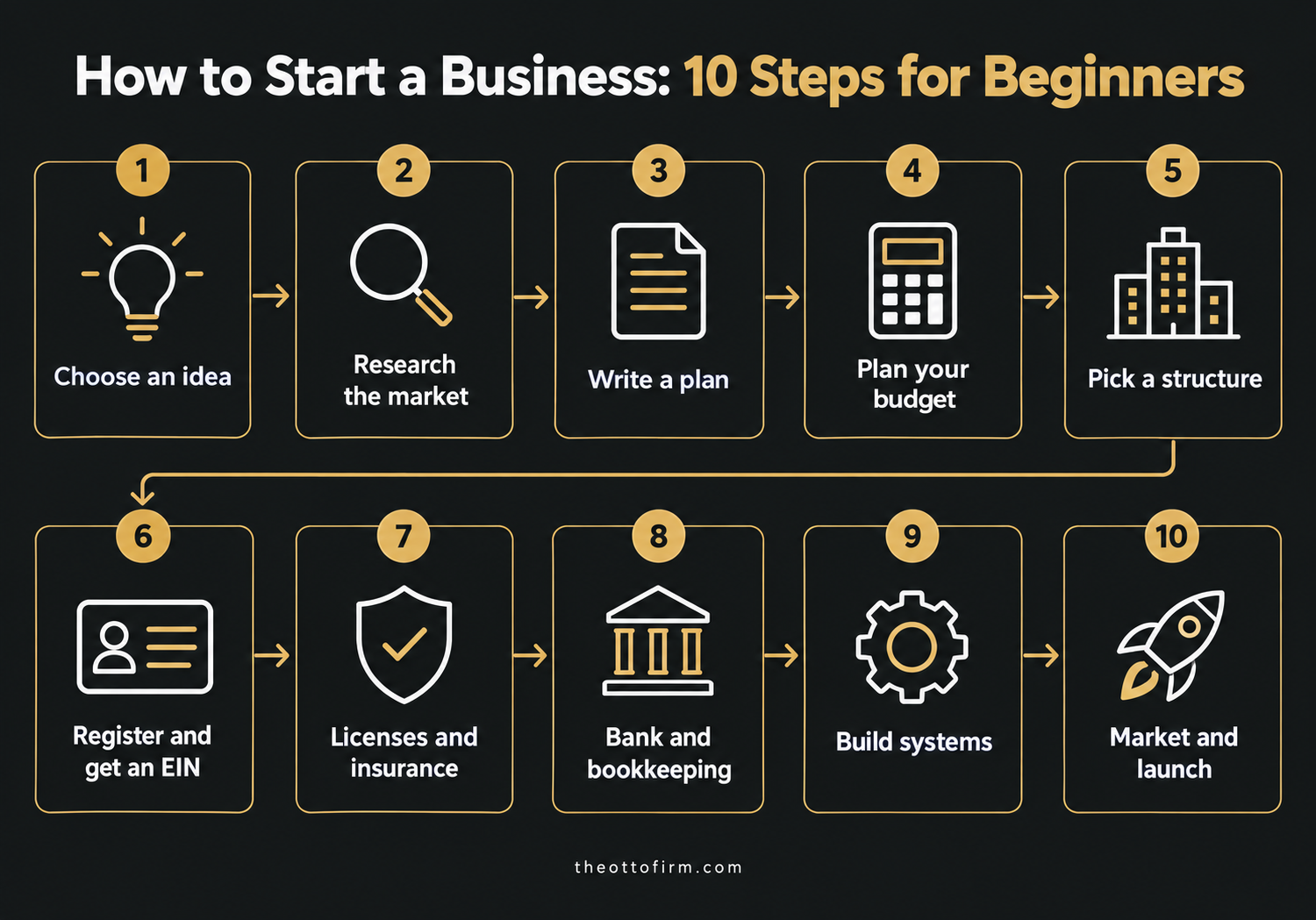
Infographic showing how to start a business for beginners in 10 steps
How to Start a Business for Beginners: Step by Step
The U.S. Small Business Administration lays out a similar path in its 10 steps to start your business guide. The steps below follow that logic and add practical tips for first time owners.
Step 1: Choose a business idea that solves a real problem
Start with what you know. Look at your skills, your work experience and the problems you see people struggle with. The best beginner businesses often solve a simple, common problem in a better way.
Why it matters: Customers pay to fix problems. An idea without a clear problem is hard to sell.
Mistake to avoid: Picking an idea only because it looks exciting online. Exciting does not always mean people will pay for it.
Step 2: Research your market
Find out who your customers are, what they buy today and what they pay. Study a few competitors and read their reviews. Customer complaints often show you exactly where you can do better.
The SBA guide to market research and competitive analysis explains how to study your customers and competitors step by step.
Why it matters: Research tells you if there is real demand before you invest time and money.
Mistake to avoid: Only doing online research. Talk to at least 10 potential customers and ask how they solve the problem today.
Step 3: Write a simple business plan
A business plan is a short document that explains what you sell, who you sell to and how you will make money. As a beginner, a few clear pages are enough. Cover your offer, your ideal customer, your pricing, your competitors and how you will find customers.
Why it matters: Writing things down forces clear thinking. It also gives you a guide to come back to when decisions get hard.
Mistake to avoid: Spending months on a perfect plan. A simple plan you actually use beats a long one that sits in a folder.
Step 4: Plan your startup budget
List every cost you expect before launch and for your first few months. Include equipment, software, registration fees, insurance, marketing and your own living costs. Then decide how you will pay for these costs, whether from savings, early sales or another source.
Why it matters: Knowing your numbers helps you price correctly and avoid running out of cash. Cash flow, the money moving in and out of your business, is something you will watch from day one.
Mistake to avoid: Forgetting to add a buffer. Most things take longer and cost more than first planned.
Step 5: Pick a legal structure
Your legal structure decides how you pay taxes and how much personal risk you carry. Common options for beginners include:
Structure | What it means | Good to know |
|---|---|---|
Sole proprietorship | You and the business are legally the same | Simple to start, but you are personally liable for business debts |
LLC (limited liability company) | A separate legal entity owned by you | Can help protect personal assets; rules and fees vary by state |
Corporation | A separate entity owned by shareholders | More paperwork; often used by businesses planning to raise outside investment |
Why it matters: The right structure can protect your personal assets and affect your taxes.
Mistake to avoid: Choosing a structure based on what a friend did. Tax and legal rules depend on your situation, so confirm your choice with a licensed CPA or attorney.
Step 6: Register your business and get an EIN
Register your business name and structure with your state's business filing office. Next, get an EIN (Employer Identification Number). Think of it as a tax ID for your business. You will usually need it to open a business bank account, hire employees and file business taxes.
You can apply for an EIN online through the IRS, and the IRS does not charge a fee for it.
Why it matters: Registration makes your business official and protects your business name.
Mistake to avoid: Paying a third party website for an EIN without realizing the IRS issues it for free.
Step 7: Get licenses, permits and insurance
Most businesses need at least one license or permit to operate legally. What you need depends on your industry and where you operate, so check with your state, county and city offices. Some industries, such as real estate, tax preparation and home services, also have professional licensing rules.
Insurance protects you if something goes wrong. Many small businesses start with general liability insurance. Service businesses often add professional liability coverage.
Why it matters: Operating without the right license can lead to fines or forced closure.
Mistake to avoid: Assuming a home based or online business needs no permits. Rules still apply, so check first.
Step 8: Open a business bank account and set up bookkeeping
Keep business money separate from personal money. Open a business checking account as soon as your business is registered. Then set up bookkeeping, which simply means recording every sale and expense. Simple accounting software makes this easy for beginners.
Why it matters: Clean records make tax time easier, help protect your legal structure and show you whether you are actually making money.
Mistake to avoid: Waiting until tax season to organize your records. Catching up months later is stressful and costly.
Step 9: Build simple systems to run the business
This is the step most beginner guides skip. Systems are what let your business run smoothly every day. Start with three basics:
A CRM (customer relationship management system) to track every lead and client in one place.
SOPs (standard operating procedures), which are short step by step guides for tasks you repeat, such as onboarding a new client.
Simple contracts and invoices so expectations and payments are clear.
Why it matters: Without systems, everything depends on your memory. That works with three customers but breaks with thirty.
Mistake to avoid: Thinking systems are only for big companies. The earlier you build them, the easier it is to grow.
Step 10: Market your business and launch
Decide where your customers spend time and show up there. For many small businesses, that means a simple website, a Google Business Profile and one or two social media channels. Above all, set up a clear process for what happens when someone reaches out.
Follow up fast. A sales pipeline, the stages a lead moves through from first contact to paying customer, helps you see who needs a reply and who is ready to buy.
Why it matters: A great business no one knows about will not survive. Fast, consistent follow up turns interest into revenue.
Mistake to avoid: Spending your whole budget on a perfect logo or website before you have talked to customers. Launch simply, then improve.
How These Steps Fit Together
These 10 steps fall into four bigger stages: strategy (Steps 1 to 4), setup and infrastructure (Steps 5 to 9), marketing and sales (Step 10) and finally launch and growth. Thinking in stages helps you see that starting a business is not one big leap. It is a series of small, clear decisions.
If you want guidance building these stages, The Otto Firm helps new owners put the strategy, operations and sales systems in place so the business is ready to run from day one.
Beginner Business Startup Checklist
Use this list to track your progress:
Business idea chosen and tested with real people
Market and competitors researched
Simple business plan written
Startup budget planned with a buffer
Legal structure chosen (confirmed with a CPA or attorney)
Business registered with your state
EIN received from the IRS
Licenses, permits and insurance in place
Business bank account opened
Bookkeeping set up
CRM, SOPs and contracts ready
Website, Google Business Profile and follow up process live
Example: A Beginner's First 90 Days
This is a made up example to show how the steps fit together, not a real client.
James has spent six years as a bookkeeper at a small firm and wants to start his own bookkeeping service. In his first month, he talks to 15 small business owners and learns that many of them are behind on their books. He writes a two page plan, sets his monthly prices and builds a simple budget.
In month two, he forms an LLC after speaking with an accountant, gets his EIN, opens a business bank account and buys insurance. He also writes SOPs for onboarding new clients and sets up a CRM to track leads.
By month three, James launches a simple website and Google Business Profile. He follows up with every inquiry the same day. Because his systems were ready before launch, his first clients get a smooth experience, and that leads to referrals.
Red Flags to Watch For
You have not talked to a single potential customer. Assumptions are not research.
Your personal and business money are mixed. Separate them as early as possible.
You are skipping licenses because "no one will check." Penalties can be costly.
Every task lives in your head. That makes it hard to grow or take a day off.
Leads wait days for a reply. Slow follow up quietly loses customers.
Frequently Asked Questions
What is the first step to starting a business?
The first step is choosing an idea that solves a real problem and testing it with potential customers. Do this before you register the business or spend money on branding.
Do I need an LLC to start a business?
No. You can start as a sole proprietor. Many owners choose an LLC because it can help separate personal and business liability. A CPA or attorney can help you decide.
Is an EIN free?
Yes. The IRS issues EINs at no cost when you apply directly through IRS.gov. Be careful with websites that charge a fee for the same application.
How long does it take to start a business?
It depends on your industry, your state and how much planning you have done. Registration can be quick, but building a plan, systems and marketing usually takes several weeks or months.
What business is easiest for beginners to start?
Service businesses built on skills you already have are often easiest, because they need little equipment. Examples include bookkeeping support, consulting, cleaning and virtual assistance.
Conclusion
Starting a business is not about doing everything at once. It is about taking the right steps in the right order. Test your idea, set up the legal and financial basics, build simple systems and then market with a clear follow up process.
Pick the step you are on today and finish it this week. Small, steady progress is how most successful businesses get started.
Not sure where your business stands? Take the free Business Readiness Assessment on theottofirm.com to see what is in place and what to focus on next. You can also book a free strategy call to talk through your plan.