How to Open an LLC in Florida: Step by Step Guide for 2026
If you plan to start a business in the Sunshine State, learning how to open an LLC in Florida is one of the smartest first moves you can make. An LLC can help keep your personal assets separate from business debts. It also gives you a simple structure that banks, lenders and customers recognize.
The filing itself is fast. The harder part is everything around it: choosing a name that passes review, setting up taxes, opening the right accounts and staying compliant every year. This guide walks you through each step in plain English so you can file with confidence and avoid the costly mistakes new owners make.
Quick Answer
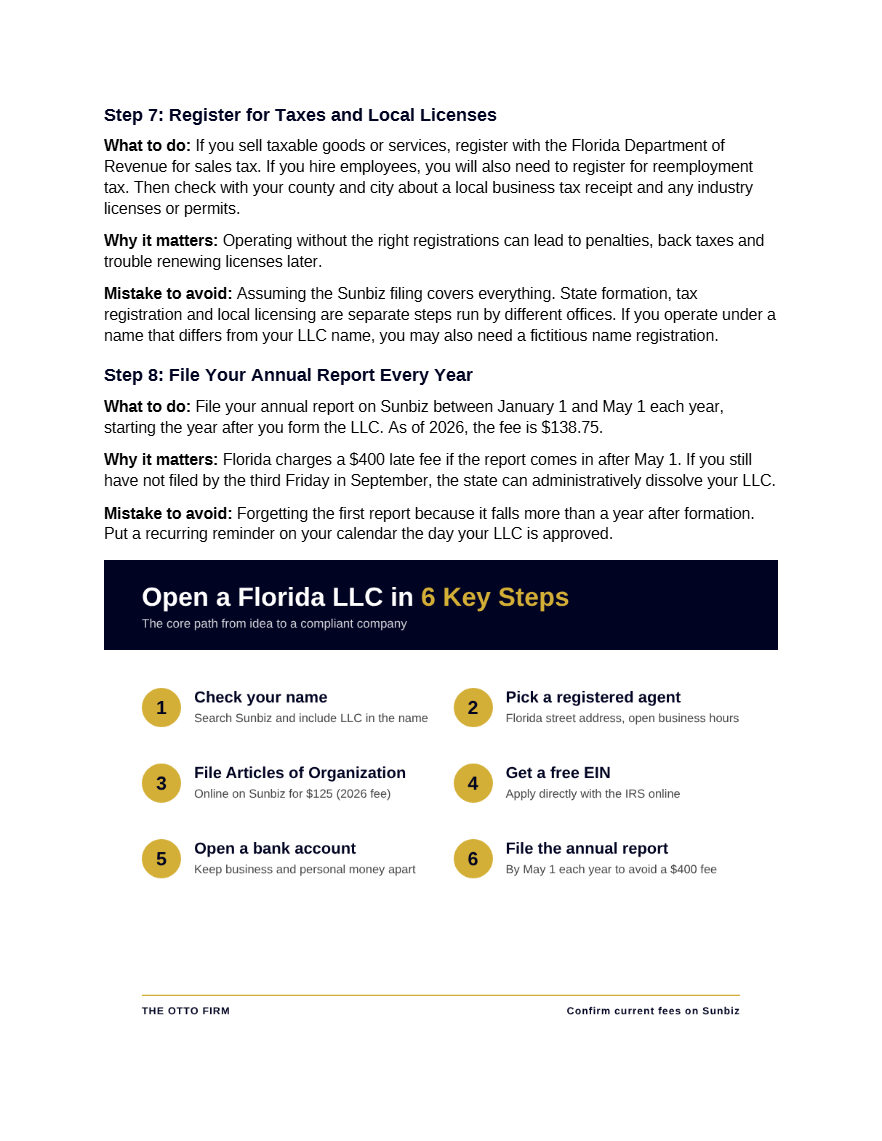
To open an LLC in Florida, follow these core steps:
1.Choose a unique name that includes "LLC" and check it on Sunbiz.
2.Pick a registered agent with a Florida street address.
3.File Articles of Organization online with the Florida Division of Corporations ($125 state fee as of 2026).
4.Get a free EIN from the IRS, then open a business bank account.
5.File your annual report between January 1 and May 1 every year.
Why Florida Business Owners Choose an LLC
A limited liability company sits between a sole proprietorship and a corporation. You get liability protection without the heavy formalities of a corporation. By default, the IRS treats a single member LLC as a disregarded entity and a multiple member LLC as a partnership, so profits pass through to the owners' personal returns.
Florida adds a few extra perks. The state does not have a personal income tax, so pass through profits are not taxed again at the state level for most owners. Filing is done online, fees are modest and the state's business records are public, which helps lenders and partners verify your company quickly.
That said, an LLC is only as strong as the habits behind it. Mixing personal and business money, skipping paperwork or missing state deadlines can weaken your protection. The steps below help you start clean.
Step by Step: How to Open an LLC in Florida
Step 1: Choose and Check Your LLC Name
What to do: Pick a name that is distinguishable from every other business already on file with the state. Search it on the Florida Division of Corporations (Sunbiz) website. Your name must end with "Limited Liability Company," "LLC" or "L.L.C."
Why it matters: Sunbiz will reject a filing if the name is too close to an existing entity. A rejected filing delays your launch and can push back your bank account, contracts and marketing.
Mistake to avoid: Do not assume an open Sunbiz name means you own the brand. Also check trademarks, domain names and social handles before you print anything.
Step 2: Pick a Registered Agent
What to do: Name a registered agent who has a physical street address in Florida (not a P.O. box) and who is available during normal business hours to receive legal papers. You can serve as your own agent if you live in Florida, or you can hire a commercial service.
Why it matters: If someone sues your LLC or the state sends an official notice, it goes to your registered agent. Missing that mail can lead to default judgments or lost good standing.
Mistake to avoid: Listing your home address makes it public on Sunbiz. If privacy matters to you, a registered agent service keeps your home address off the public record.
Step 3: File Articles of Organization on Sunbiz
What to do: File the Articles of Organization online through Sunbiz. You will enter your LLC name, principal and mailing addresses, registered agent details with the agent's signature, plus any managers or authorized representatives. As of 2026, the state fee is $125, which covers the $100 filing fee plus the $25 registered agent designation.
Why it matters: This filing is what legally creates your LLC. Once the state accepts it, you receive a document number that you will use for banking, licenses and the annual report.
Mistake to avoid: Typos in the name or addresses become part of the public record. Fixing them later requires an amendment with its own fee, so review every field before you submit.
Step 4: Write an Operating Agreement
What to do: Create a written operating agreement that covers ownership percentages, voting, profit splits, what happens if a member leaves and how the business can be sold or closed. Florida does not require you to file it with the state, but you should keep it with your company records.
Why it matters: Banks often ask for it. Investors and lenders want to see who controls the company. For a single owner, it also helps show that the LLC is a real, separate business.
Mistake to avoid: Copying a free template without reading it. A generic agreement may not match how you and your partners actually plan to run the business.
Step 5: Get an EIN From the IRS
What to do: Apply for an Employer Identification Number directly through the IRS EIN application page. It is free when you apply with the IRS. Most applicants with a valid taxpayer ID can finish online in one session.
Why it matters: You need an EIN to open a business bank account, hire employees, file certain tax returns and apply for most business credit.
Mistake to avoid: Paying a third party site for an EIN without realizing the IRS issues it for free. Always confirm you are on IRS.gov.
Step 6: Open a Business Bank Account
What to do: Bring your filed Articles, EIN confirmation letter, operating agreement and a valid ID to the bank. Run every business dollar through this account.
Why it matters: Separate accounts protect your liability shield, make bookkeeping simpler and build the financial history you will need when you apply for funding.
Mistake to avoid: Paying personal bills from the business account or depositing business income into your personal account. This is one of the fastest ways to blur the line between you and your LLC.
Step 7: Register for Taxes and Local Licenses
What to do: If you sell taxable goods or services, register with the Florida Department of Revenue for sales tax. If you hire employees, you will also need to register for reemployment tax. Then check with your county and city about a local business tax receipt and any industry licenses or permits.
Why it matters: Operating without the right registrations can lead to penalties, back taxes and trouble renewing licenses later.
Mistake to avoid: Assuming the Sunbiz filing covers everything. State formation, tax registration and local licensing are separate steps run by different offices. If you operate under a name that differs from your LLC name, you may also need a fictitious name registration.
Step 8: File Your Annual Report Every Year
What to do: File your annual report on Sunbiz between January 1 and May 1 each year, starting the year after you form the LLC. As of 2026, the fee is $138.75.
Why it matters: Florida charges a $400 late fee if the report comes in after May 1. If you still have not filed by the third Friday in September, the state can administratively dissolve your LLC.
Mistake to avoid: Forgetting the first report because it falls more than a year after formation. Put a recurring reminder on your calendar the day your LLC is approved.
Florida LLC Costs at a Glance (2026)
Here is what the state charges for the most common filings as of 2026. Fees can change, so confirm them on Sunbiz before you file.
Item | State Fee (2026) | Required? |
Articles of Organization filing | $100 | Yes |
Registered agent designation | $25 | Yes |
Certified copy of Articles | $30 | Optional |
Certificate of status | $5 | Optional |
EIN from the IRS | Free | Yes, for most LLCs |
Annual report (Jan 1 to May 1) | $138.75 | Yes, every year |
Late annual report fee | $400 extra | Only if filed after May 1 |
Your real budget will likely include more than state fees. Plan for a registered agent service if you use one, local business tax receipts, industry licenses, bookkeeping software and professional help with taxes or contracts.
Red Flags to Watch For
•A mailer that looks official and asks you to pay for a "certificate of status" or "compliance report." These are often private companies, not the state.
•Websites that charge a fee for an EIN without making clear the IRS offers it for free.
•Any service promising your LLC will guarantee funding, credit approval or tax savings.
•A partner who refuses to put ownership terms in a written operating agreement.
•Business expenses paid from a personal card with no clear records.
Example: A First 30 Day Plan for a New LLC
Illustrative example (not a real client): Maria wants to open a mobile pet grooming business in Miami. In week one, she checks her name on Sunbiz, confirms the domain is open and hires a registered agent service to keep her home address private. In week two, she files her Articles of Organization and drafts an operating agreement. In week three, she gets her EIN from the IRS, opens a business checking account and registers with the Florida Department of Revenue. In week four, she applies for her county and city business tax receipts, sets up bookkeeping and adds a May 1 reminder for next year's annual report.
By the end of the month, Maria has more than a filing receipt. She has a business with clean records, separate finances and a clear compliance calendar.
Do Florida LLCs Still File Beneficial Ownership Reports?
Many new owners still hear about beneficial ownership information (BOI) reports. In March 2025, the Financial Crimes Enforcement Network issued an interim final rule that exempts companies created in the United States from BOI reporting. Rules in this area have changed several times, so check the FinCEN BOI page for the latest guidance before you rely on the exemption.
Beyond the Filing: Building a Business That Is Ready to Run
Forming the LLC is step one. Many owners stall after the filing because they still need a business plan, credit profile, brand, website, sales process and systems that support growth. That gap is where The Otto Firm helps. Our 120 day Business Build walks entrepreneurs through Foundation, Infrastructure, Marketing and Sales, then Launch and Growth, so the business is ready to operate, fund and sell.
You can learn more about the approach on our What We Do page.
Frequently Asked Questions
How much does a Florida LLC cost to start?
As of 2026, the state fee is $125: a $100 filing fee plus a $25 registered agent designation. Plan for a $138.75 annual report each year after that.
How long does it take to form a Florida LLC?
Online filings are usually processed within a few business days. Processing times change during busy periods, so check Sunbiz for current estimates.
Can I be my own registered agent in Florida?
Yes, if you have a Florida street address and can be there during normal business hours. Keep in mind that address becomes part of the public record.
Do I need an operating agreement in Florida?
Florida does not require you to file one, but you should have one. Banks, lenders and partners often ask for it. It also sets clear rules for ownership.
What happens if I miss the May 1 annual report deadline?
Florida adds a $400 late fee. If you still have not filed by the third Friday in September, the state can administratively dissolve your LLC.
Note: This article is general information. For tax, legal or financing decisions, confirm your situation with a licensed CPA, tax professional or attorney.
Conclusion: Your Next Step
Opening a Florida LLC is straightforward when you take it one step at a time: check your name, choose a registered agent, file on Sunbiz, get your EIN, open a bank account, handle tax and local registrations, then protect your good standing with the annual report. Do these well and you start with a business that lenders and customers can trust.
Ready to build more than an LLC? Take the free Business Readiness Assessment to see where your business stands today, or book a free strategy call at theottofirm.com.