How to Build Business Credit Without Using Personal Credit
Many owners want their business to stand on its own financially. They do not want every card, loan or vendor account tied to their personal credit. If you are looking for how to build business credit without using personal credit, the honest answer is that it takes time and a deliberate plan.
Most new businesses still rely on the owner’s credit at the start. The goal is to build a business credit profile strong enough that lenders and vendors can judge your company on its own record. This guide shows you how to get there step by step and which shortcuts to avoid.
Quick Answer
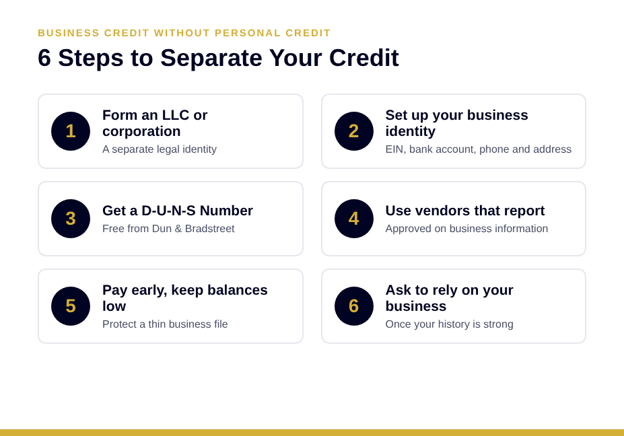
You can build business credit that relies less on your personal credit over time. Form an LLC or corporation, set up your EIN and business accounts, get a D-U-N-S Number, open vendor accounts that approve based on business information and report to business bureaus, then pay early. As your history grows, ask creditors to rely on your business alone.
What Without Personal Credit Really Means
There are three ways personal credit can show up in your business finances. A creditor may check your personal credit when you apply. It may ask you to sign a personal guarantee. It may also report the account to your personal credit reports.
Building business credit without personal credit means reducing all three over time. At the start, it is common to need at least one of them. According to Experian, many creditors are moving away from relying on personal credit alone and toward blended scoring that looks at both the owner and the business.
So the realistic goal is not to avoid personal credit on day one. It is to build a business record strong enough that creditors can lean on it more and on you less.
Why is this worth the effort? Separate credit protects your personal score from the ups and downs of the business. It can make it easier to qualify for a mortgage or car loan without business debt getting in the way. It also makes your company more attractive to lenders, partners and future buyers, because the business has its own track record.
Step by Step: Separate Your Business Credit
Step 1: Form an LLC or Corporation
What to do: Register your business as an LLC or corporation with your state instead of operating as a sole proprietor.
Why it matters: Experian notes that for sole proprietors, personal credit and business credit are closely linked in the eyes of lenders. A separate legal entity is the first step to a separate credit identity.
Mistake to avoid: Forming an entity but still running everything in your own name. The entity only helps if you actually use it.
Step 2: Set Up Your Business Identity
What to do: Get a free EIN from the IRS. Open a business bank account in the legal business name. Add a business phone number and a stable business address. Use the same details on every account.
Why it matters: Credit bureaus match records by business name, EIN, address and phone. Consistent details help your payments land in one clear business file.
Mistake to avoid: Using your personal phone, address or bank account for business accounts. It ties your business back to you personally.
Step 3: Get a D-U-N-S Number
What to do: Request a D-U-N-S Number from Dun & Bradstreet to start your business file there.
Why it matters: Dun & Bradstreet says the number is free and usually arrives within 30 business days. It creates a unique identity for your business that other companies can use to assess it.
Mistake to avoid: Waiting until you need credit to request it. Start early so it is ready when you apply.
Step 4: Start With Vendor Accounts Based on Business Information
What to do: Look for suppliers that offer net 30 terms and approve accounts using your business details. Ask each vendor whether it checks personal credit and whether it requires a personal guarantee.
Why it matters: Some vendors approve new businesses based on business information alone, sometimes after a prepaid first order. These accounts can build business credit without touching your personal file.
Mistake to avoid: Assuming every vendor works this way. Policies vary, so always ask before you apply and keep a note of each answer.
Step 5: Choose Accounts That Report to Business Bureaus
What to do: Ask each vendor or card issuer which credit bureaus it reports to. Favor accounts that report to business credit bureaus.
Why it matters: Only reported payments build your business file. An account that reports only to your personal file does little for your business credit.
Mistake to avoid: Opening accounts that never report. They do not help you separate your credit.
Step 6: Pay Early and Keep Balances Low
What to do: Pay every invoice on time or early. On any revolving account, keep balances low compared to your limit.
Why it matters: Payment history plays a major role in business credit scores. Experian suggests keeping balances at about 20% to 30% of your credit limit.
Mistake to avoid: Letting a single late payment slip. A thin business file is easily hurt by one bad mark.
Step 7: Ask to Rely on Your Business Record
What to do: Once your business has a solid payment history and steady revenue, ask creditors whether they can approve new credit or higher limits based on your business alone. Ask whether an existing personal guarantee can be reduced or removed.
Why it matters: Creditors may be more flexible when your business shows a strong track record. You will not know unless you ask.
Mistake to avoid: Expecting this in your first months. It usually takes a real history of revenue and on time payments.
Step 8: Monitor Both Your Business and Personal Reports
What to do: Check your business credit reports regularly. Also check your personal reports to see whether any business accounts appear there.
Why it matters: Monitoring shows whether your separation plan is working. It also helps you catch errors early.
Mistake to avoid: Ignoring your personal reports. Business accounts you guaranteed may still affect you personally.
How Reliance on Personal Credit Usually Changes
Stage | What you use | Role of personal credit |
Just formed | EIN, bank account, D-U-N-S Number | Often checked for most new credit |
First months | Vendor accounts that report | Lower for some vendor accounts |
Growing history | More vendors and a business card | Still common, often with a guarantee |
Established | Larger credit lines and loans | May decrease as the business record grows |
Every business moves through these stages at its own pace. Revenue, payment history and time in business all play a part.
Red Flags: Shortcuts That Can Get You in Trouble
Some companies promise to help you build credit with no personal credit at all. Be careful. The Federal Trade Commission warns that some credit repair companies get people to apply for EINs under false pretenses to create new credit reports. The FTC says that if a company promises to create a new credit identity, that is a scam.
•Offers to give you a new credit number to use instead of your Social Security number
•Advice to use your EIN in place of your SSN on personal credit applications
•Guarantees of large business credit lines with no checks of any kind
•Paid packages that add tradelines you never actually used
•Pressure to pay large upfront fees for a business credit program
The FTC also warns that using a number other than your own to apply for credit can lead to fines or even prison. Real business credit takes real activity over time.
Habits That Keep Business and Personal Credit Separate
•Never pay business bills from your personal accounts
•Use your business name and EIN on every business application
•Keep bookkeeping current so your numbers are always ready
•Read every application to see if it includes a personal guarantee
•Review new account terms for which bureaus they report to
These habits protect your personal credit and make your business look more established. They also make tax time and lender reviews much easier.
Example: A Growing Consulting LLC
This is a hypothetical example, not a real client. Imagine a consultant who forms an LLC and wants her business credit to stand on its own.
1.She gets an EIN, a business bank account and a business phone number.
2.She requests a D-U-N-S Number in her first month.
3.She opens two vendor accounts that approve based on business details and report to business bureaus.
4.She adds a business credit card. It requires her personal guarantee at first.
5.She pays every bill early for two years while her revenue grows.
6.She asks her card issuer to review her account based on her business history.
Her business credit now carries much of the weight. She still checks her personal reports, but her business no longer depends on them for every decision.
Build the Structure That Supports Business Credit
Separating business and personal credit starts with how your business is set up. At The Otto Firm, we help owners build that structure, including entity setup, banking, bookkeeping and systems, through our 120 day Business Build.
Frequently Asked Questions
Can I get business credit with no personal credit check at all?
Sometimes, mainly with certain vendor accounts. Most business credit cards and loans still check personal credit for new businesses.
Does getting an EIN build business credit?
No. An EIN identifies your business, but credit is built when accounts report your payments to business credit bureaus.
When can I stop signing personal guarantees?
There is no set timeline. Creditors may be more flexible once your business has steady revenue and a strong payment history. Ask each one directly.
Can business credit affect my personal credit?
It can if an account reports to your personal bureaus or if you personally guarantee a debt that goes unpaid. Read your account terms carefully.
This guide is general information, not legal, tax or financial advice. Talk to a licensed attorney, CPA or financial professional about your specific situation.
Your Next Step
Building business credit that stands on its own is a process, not a shortcut. Set up a separate entity and business identity, open accounts that report to business bureaus and pay early every month. As your history grows, ask creditors to rely on your business record.
Want to know how ready your business is to stand on its own? Take the free Business Readiness Assessment to see where you stand, or book a free strategy call at theottofirm.com.