How to Build Business Credit for a New LLC: Step by Step
Forming an LLC gives your business its own legal identity. It does not give it a credit history. If you want to know how to build business credit for a new LLC, the key is to set up your business so credit bureaus can find it, then create a record of paying on time.
This guide walks you through each step in order, from your EIN and bank account to vendor accounts and business credit cards. You will also learn how business credit differs from personal credit, what to avoid and how long the process usually takes.
Quick Answer
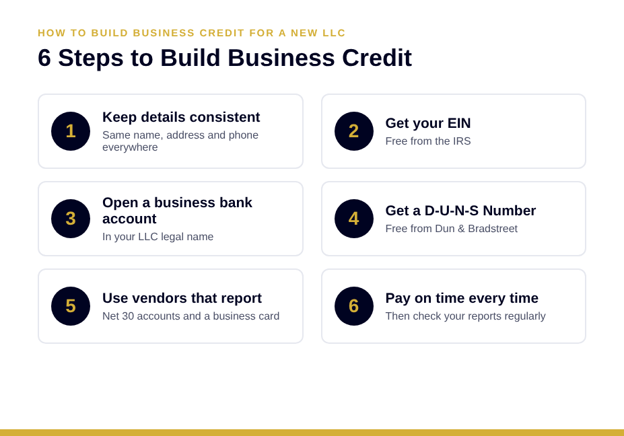
To build business credit for a new LLC, follow these steps:
1.Make sure your LLC details are consistent everywhere
2.Get a free EIN from the IRS
3.Open a business bank account in the LLC name
4.Set up a business phone number and address
5.Get a free D-U-N-S Number from Dun & Bradstreet
6.Open vendor accounts that report to business credit bureaus
7.Add a business credit card and keep balances low
8.Pay on time and check your business credit reports
Business Credit vs. Personal Credit
Personal credit follows you as an individual and is tied to your Social Security number. Business credit follows your company and is tied to your business name, EIN and other business details.
The main business credit bureaus include Dun & Bradstreet, Experian and Equifax. According to Experian, its business credit scores range from 0 to 100, where a higher score means lower risk. Scores look at factors such as payment history, balances, public records and how long the business has been on file.
Why build it? Strong business credit can help your LLC qualify for better vendor terms, business credit cards and loans. Over time, it can also reduce how much lenders rely on your personal credit. Keep in mind that most new businesses still need the owner’s personal credit and a personal guarantee at first.
How to Build Business Credit for a New LLC
Step 1: Make Your LLC Details Consistent
What to do: Confirm your LLC is active with your state. Use the exact same legal name, address and phone number on every account and filing.
Why it matters: Credit bureaus match records by your business details. Small differences, like an extra word or a different suite number, can split your history into separate files.
Mistake to avoid: Using a DBA on some accounts and your legal name on others without a plan. Pick one format and stick to it.
Step 2: Get a Free EIN From the IRS
What to do: Apply for an Employer Identification Number on IRS.gov. The application is free.
Why it matters: Your EIN works like a Social Security number for your business. Lenders and vendors use it to open accounts and report payments in your business name.
Mistake to avoid: Paying a third party website for an EIN. The IRS does not charge for it.
Step 3: Open a Business Bank Account
What to do: Open a checking account in your LLC’s legal name using your EIN. Run all business income and expenses through it.
Why it matters: A business bank account supports your LLC as a separate entity. Experian lists business bank accounts in the legal business name as part of establishing business credit.
Mistake to avoid: Paying business bills from your personal account. It blurs your records and weakens the separation between you and your LLC.
Step 4: Set Up a Business Phone and Address
What to do: Get a dedicated business phone number and list it under your business name. Use a business address you can keep long term.
Why it matters: A listed business phone line is one of the basic details that helps your business look established to bureaus and lenders.
Mistake to avoid: Changing your address or number often. Every change can create mismatched records.
Step 5: Get a Free D-U-N-S Number
What to do: Request a D-U-N-S Number from Dun & Bradstreet. This nine digit number gives your business its own file in the Dun & Bradstreet system.
Why it matters: Dun & Bradstreet says there is no cost to request and receive a D-U-N-S Number. In most cases, it arrives within 30 business days. Many large companies and government agencies ask for one.
Mistake to avoid: Paying for a faster number if you are not in a hurry. The paid expedited option is optional.
Step 6: Open Vendor Accounts That Report
What to do: Open accounts with suppliers that let you buy now and pay later, often on net 30 terms. Before you sign up, ask whether they report your payments to business credit bureaus.
Why it matters: Experian notes that not all business creditors report trade information. Only reported payments help build your business credit file.
Mistake to avoid: Buying things you do not need just to build credit. Choose vendors you will actually use for supplies, shipping or office needs. Start with one or two, then add more as your business grows.
Step 7: Add a Business Credit Card
What to do: Apply for a business credit card in your LLC name. Ask the issuer whether it reports to business credit bureaus.
Why it matters: A card in good standing adds another account to your business credit history. Experian suggests keeping balances at about 20% to 30% of your credit limit.
Mistake to avoid: Carrying high balances month to month. High use of available credit can hurt your score.
Step 8: Pay on Time and Check Your Reports
What to do: Pay every account on time or early. Check your business credit reports regularly and dispute any errors.
Why it matters: Payment history plays a major role in business credit scores. Regular checks help you catch mistakes before a lender sees them.
Mistake to avoid: Assuming your reports are correct. Errors happen. A wrong record can follow your business for years.
The Main Business Credit Bureaus
Bureau | How your file starts | What to know |
Dun & Bradstreet | Request a free D-U-N-S Number | Often requested by large companies and agencies |
Experian | Trades reported in your business name | Scores range from 0 to 100 |
Equifax | Accounts reported by lenders and vendors | Some lenders check it alongside the others |
Each bureau collects data a little differently, so your scores may not match. That is normal. Focus on paying on time and keeping your details consistent with all three, rather than chasing a single number on one report.
Business Credit Checklist
•LLC active with your state and details consistent everywhere
•EIN from the IRS
•Business bank account in the LLC name
•Listed business phone number and stable address
•D-U-N-S Number from Dun & Bradstreet
•Two or more vendor accounts that report payments
•Business credit card with low balances
•Calendar reminders for every payment due date
Red Flags to Avoid
•Companies that promise instant business credit or a guaranteed score
•Paid packages that claim to add tradelines you never actually use
•Anyone offering a new credit number to use instead of your Social Security number
•Vendors that charge high membership fees just to open a net 30 account
•Advice to apply for many cards at once to build credit faster
Experian notes there is no guaranteed way to improve a business credit score. Building it takes consistent, real activity over time.
Habits That Keep Your Business Credit Strong
Building business credit is not a one time project. Once your file exists, these habits help it grow stronger every year:
•Set up automatic payments or calendar reminders for every due date
•Review your business bank account and statements each week
•Keep your bookkeeping current so you always know what you owe
•Update all bureaus and vendors right away if your address or phone changes
•Add new credit slowly, only when your business has a real need for it
These habits also make your business easier to run. Clean books and on time payments help you plan cash flow, talk to lenders with confidence and make better decisions.
Example: A New Landscaping LLC
This is a hypothetical example, not a real client. Imagine an owner who forms a landscaping LLC and wants to build business credit during the first year.
1.He gets an EIN and opens a business checking account in the LLC name the same week.
2.He sets up a business phone line and uses the same address on every form.
3.He requests a free D-U-N-S Number and waits for it to arrive.
4.He opens net 30 accounts with a supply company and an equipment parts vendor that confirm they report.
5.He adds a business credit card for fuel and keeps the balance low.
6.He pays every bill a few days early and checks his reports every quarter.
After several months of reported, on time payments, his LLC has a real business credit history he can build on.
Set Up the Foundation First
Business credit grows best when the basics are in place. At The Otto Firm, we help owners set up the foundation of their business, including structure, banking, bookkeeping and systems, through our 120 day Business Build. That way your LLC is organized from day one.
Frequently Asked Questions
How long does it take to build business credit?
There is no fixed timeline. Most new LLCs need several months of reported, on time payments before a score is meaningful. Getting a D-U-N-S Number alone can take up to 30 business days.
Does my LLC have its own credit score?
Not automatically. Your LLC gets a business credit file once bureaus receive information about it, such as reported payments from vendors and lenders.
Will I need a personal guarantee?
Usually, at first. Most lenders ask new business owners to personally guarantee credit until the business builds its own history.
Can I check my business credit report?
Yes. Business credit bureaus such as Dun & Bradstreet, Experian and Equifax offer ways to view your business credit file.
This guide is general information, not legal, tax or financial advice. Talk to a licensed attorney, CPA or financial professional about your specific situation.
Your Next Step
Building business credit is a series of simple steps done in the right order. Set up your LLC details, open accounts that report and pay on time every month. Check your reports regularly so you know exactly where you stand.
Want to know what else your business needs to be ready to grow? Take the free Business Readiness Assessment to see where you stand, or book a free strategy call at theottofirm.com.