Business Readiness Assessment: What It Is and Why It Matters
Most business owners work hard, but many are not sure which part of their business is holding them back. Is it sales? Systems? Money? A business readiness assessment answers that question. It gives you a clear picture of where your business stands today and what needs attention first.
In this guide, you will learn what a business readiness assessment is, what it checks, who should take one and how to turn your results into a simple action plan. By the end, you will know exactly how to use an assessment to stop guessing and start fixing the right things.
Quick Answer
A business readiness assessment is a short set of questions that scores how prepared your business is across key areas, such as strategy, systems, sales and finance. It shows your strengths, your gaps and what to fix first, so you can focus your time and money where they matter most.
What Is a Business Readiness Assessment?
A business readiness assessment is a structured check of how prepared your business is to operate, sell and grow. Think of it like a health checkup for your company. Instead of looking at one problem at a time, it looks at the whole business and shows how each part is doing.
You answer questions about how your business works today. Then you get a score or rating for each area. The result shows where you are strong, where you are weak and which gaps are most likely to slow you down.
Who should take a business readiness assessment?
An assessment helps at almost every stage:
You have a business idea. It shows what you need to set up before you launch.
You formed a business but have no systems. It shows which foundations are missing, such as a sales process or clean finances.
You run an established business that feels stuck. It helps you find the real bottleneck instead of guessing.
Why guessing is expensive
Without a clear view of your business, it is easy to fix the wrong thing. You might spend on ads when the real problem is slow follow-up. You might hire help when the real problem is that nothing is written down. An assessment helps you put your time and money where they will actually make a difference.
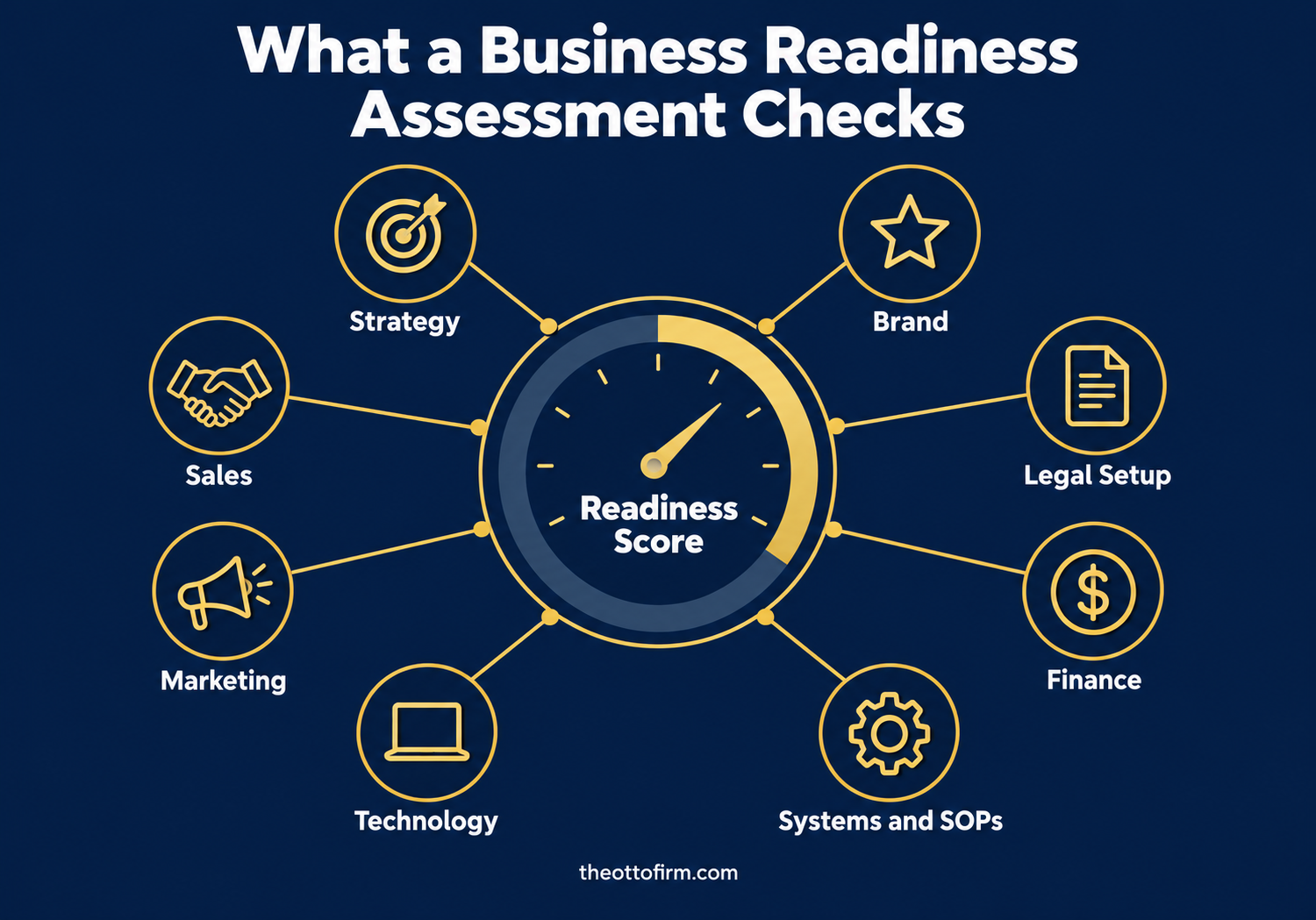
What a Business Readiness Assessment Checks
Every assessment is a little different, but a thorough one usually looks at these core areas:
Area | What it checks | Sign you are ready |
|---|---|---|
Strategy | Your business model, ideal customer, pricing and goals | You can explain who you serve and how you make money in one sentence |
Brand and positioning | How clearly you stand out from competitors | Customers understand why they should choose you |
Legal setup | Your business structure, registration, EIN, licenses and contracts | Your business is properly registered and your agreements are in writing |
Finance | Bookkeeping, invoicing, cash flow and a separate business bank account | You know your monthly revenue, expenses and profit |
Systems and SOPs | Written processes for tasks you repeat | Your team can complete key tasks without asking you every time |
Technology | Your CRM, email, payments and client tools | Leads, clients and payments are tracked in one place |
Marketing | How people find you and how leads come in | You have at least one steady source of new leads |
Sales | Your follow-up, pipeline and proposals | Every lead gets a fast reply and a clear next step |
A few of these terms may be new. A CRM (customer relationship management system) keeps track of every lead and client. SOPs (standard operating procedures) are step by step guides for repeat tasks. A sales pipeline shows each stage a lead moves through, from first contact to paying customer. Cash flow is the money moving in and out of your business each month.
For the legal basics, the U.S. Small Business Administration's 10 steps to start your business is a helpful reference. Legal and tax requirements depend on your state and situation, so confirm the details with a licensed CPA or attorney.
Why every area matters together
A business is a system. A great marketing plan fails if sales follow-up is slow. Strong sales create stress if bookkeeping is a mess. An assessment shows how the pieces connect, so you can build a business that works as a whole, from strategy and infrastructure to marketing, sales and launch.
How to Use Your Business Readiness Assessment Results
Taking the assessment is the easy part. The value comes from what you do next. Follow these steps.
Step 1: Answer honestly
Answer based on how your business works today, not how you plan for it to work. If a process only lives in your head, it does not count as a system yet.
Why it matters: Honest answers give you an accurate score. Optimistic answers hide the exact problems you need to find.
Mistake to avoid: Rushing through the questions. Take a few quiet minutes and think about real examples from the last month.
Step 2: Find your lowest scoring area
Look at your results and circle the one or two weakest areas. These are usually the bottlenecks slowing everything else down.
Why it matters: Fixing your weakest link often improves several other areas at the same time.
Mistake to avoid: Starting with the area you enjoy most. Owners often spend time on branding because it is fun, while the real gap is in finance or follow-up.
Step 3: Pick one fix for the next 30 days
Choose one clear action for your weakest area. For example, set up a separate business bank account, write your first SOP or add an automatic reply for new leads.
Why it matters: One finished fix beats ten half-started projects.
Mistake to avoid: Trying to fix everything at once. That usually leads to burnout and nothing getting done.
Step 4: Build a simple 90 day plan
List the next three or four fixes in order of impact. Give each one a deadline and an owner, even if the owner is you.
Why it matters: A written plan turns your results into progress you can track.
Mistake to avoid: Keeping the plan in your head. Write it down where you will see it every week.
Step 5: Retake the assessment
After a few months, take the assessment again. Compare your new scores with your first ones to see what improved and what still needs work.
Why it matters: Progress you can see keeps you motivated and shows where to focus next.
Mistake to avoid: Treating the assessment as a one time event. Your business changes, so your priorities will too.
Example: Turning Results Into Action
This is a made up example to show how the process works, not a real client.
Dana runs a small bookkeeping service with two part time helpers. She feels busy all the time but is not growing. Her assessment shows strong scores in strategy and service quality but low scores in systems and sales.
She picks one fix for the first month: a written onboarding process for new clients. In month two, she sets up a CRM so every inquiry gets a reply the same day. When she retakes the assessment three months later, her systems and sales scores are higher, and she spends less time answering the same questions.
Red Flags Your Business Is Not Ready to Grow
You cannot name your monthly profit. Your finances need attention first.
Leads wait days for a reply. Your sales process is leaking customers.
Your team needs you for every decision. Your processes are not written down.
Your business and personal money are mixed. Your records and legal setup are at risk.
Growth makes things harder, not easier. Your systems cannot handle more volume yet.
Frequently Asked Questions
What is a business readiness assessment?
It is a short set of questions that scores how prepared your business is across key areas, such as strategy, systems, sales and finance. It shows your strengths, your gaps and what to fix first.
How long does a business readiness assessment take?
It depends on the assessment. The free assessment from The Otto Firm takes about three minutes and gives you a score across ten areas of your business.
Is a business readiness assessment only for new businesses?
No. It helps at every stage, from an idea to an established business that feels stuck. Each stage simply has different gaps to find.
What should I do after I get my results?
Start with your lowest scoring area. Pick one fix for the next 30 days, build a simple 90 day plan and retake the assessment after a few months to track progress.
How often should I take a business readiness assessment?
A good rhythm is every few months, or whenever your business changes, such as before hiring, launching a new service or trying to grow faster.
Conclusion
You cannot fix what you cannot see. A business readiness assessment gives you a clear, honest view of your business, so you stop guessing and start working on the changes that matter most.
Your next step is simple: take an assessment, find your weakest area and choose one fix to finish this month.
Ready to see where your business stands? Take the free Business Readiness Assessment on theottofirm.com. In about three minutes, you will see your score and what to fix first. Want help turning your results into a plan? You can also book a free strategy call.