How to Build a Business Launch Plan: Step-By-Step Guide
What is a Business Launch Plan and Why You Need One
A successful company requires more than a great idea. To turn your business concept into a profitable company, you need a clear business launch plan that aligns your team, software tools, client onboarding and marketing campaigns. A launch plan transforms high level strategy into daily execution tasks with specific deadlines and defined owners.
Many entrepreneurs confuse a traditional business plan with a business launch plan. A standard business plan focuses on your business model, executive summary and long term financial projections to attract investors or secure bank financing. In contrast, a business launch plan focuses on operational readiness, marketing rollout and customer acquisition. It acts as a tactical project manager for your pre-launch, soft launch, grand opening and post-launch review phases.
Phase 1: Pre-Launch Strategy and Business Foundation
Before spending money on public advertising or social media promotion, you must establish a stable legal and financial foundation. Launching marketing campaigns before your operational structure is ready leads to missed lead follow ups, bad customer experiences and administrative delays.
Brand Positioning and Pricing Strategy
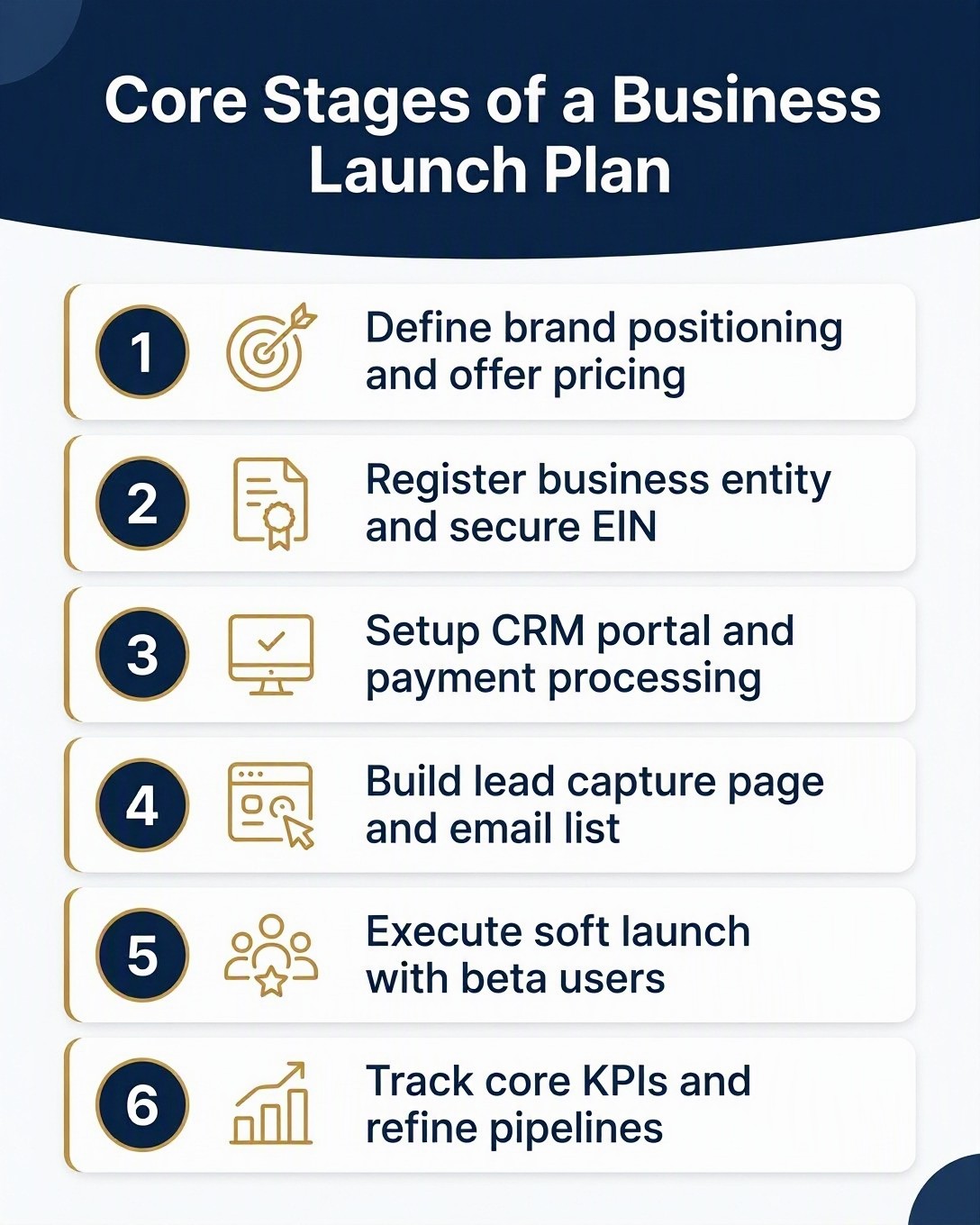
Your brand positioning defines how your business stands out in your market sector. You must identify your target audience, clarify your primary offer and set pricing that supports healthy profit margins. Small business owners often make the mistake of underpricing services to gain early traction. Research your direct competitors and set prices based on the tangible value you deliver rather than trying to be the lowest cost option in town.
Legal Formation and Financial Setup
Select an appropriate business entity such as a Limited Liability Company (LLC) or corporate entity to protect your personal assets. You can register your company directly through state registration portals like the Florida Division of Corporations or your local state government filing agency. Once registered, apply for an Employer Identification Number (EIN) through the official IRS website to establish your business tax identity.
Open a dedicated business bank account and set up cloud bookkeeping software to track income and expenses from day one. You should also evaluate general liability insurance and business credit options through resource centers like the U.S. Small Business Administration to protect your company assets. Always confirm specific legal, tax and regulatory requirements with a licensed attorney or CPA for your specific situation.
Phase 2: Operational Infrastructure and Systems
A solid infrastructure ensures that every client receives a seamless experience from the moment they submit an inquiry. Establishing software systems during your pre-launch phase prevents operational bottlenecks as customer demand grows.
CRM and Client Onboarding Integration
Your customer relationship management (CRM) software serves as the central hub for your client communication and sales pipeline. Choose a CRM that connects smoothly with your email marketing provider, contract signing software and payment processing gateway. Set up automatic client portals, invoice templates and electronic contract delivery to eliminate manual administration tasks.
Building these core systems can feel overwhelming during a company launch. Business consulting support like the systems built through The Otto Firm helps business owners install CRM software, payment processing platforms and standard operating procedures before opening to public clients.
Standard Operating Procedures (SOPs)
Document every essential workflow in simple standard operating procedures (SOPs). Create written guidelines for client intake, proposal delivery, service execution, customer support response times and weekly financial reviews. SOPs eliminate operational confusion and allow new team members to execute routine operations consistently.
Phase 3: Marketing Engine and Sales Pipeline
Your marketing campaign should build audience interest before your official grand opening date. A multi-channel promotional strategy ensures a steady stream of qualified sales leads on day one.
Email List Building and Social Media Warmup
Start building an email list at least 30 to 60 days before your launch date. Build a high converting landing page that offers a helpful lead magnet, exclusive pre-launch pricing or early platform access in exchange for contact information. Maintain active social media profiles on channels where your target market spends time, sharing useful educational content and behind the scenes development updates.
Sales Pipeline and Follow-Up Automation
A flood of leads will not generate revenue unless you maintain an organized sales pipeline. Map out every stage of your sales process from initial contact to proposal delivery and agreement signing. Set up automated email reminders and SMS follow ups to keep potential clients engaged throughout the decision window.
Phase 4: Executing Your Launch Timeline
A structured timeline prevents last minute technical errors and keeps your team aligned on essential priorities. Breaking your rollout into distinct testing and promotional phases guarantees a smooth transition to public operations.
The Soft Launch Testing Phase
Conduct a soft launch 14 to 30 days before your public grand opening. Invite a small group of trusted beta clients, past contacts or industry partners to test your onboarding workflows, purchase products and review your client service process. Use this trial period to catch software glitches, refine your client communication templates and adjust your sales pipeline settings.
Grand Opening Campaign Execution
Your grand opening marks the full public release of your products or services. Execute a strategic marketing push using targeted paid search ads, local PR outreach, email marketing announcements and organic social media content. Focus messaging on how your solution solves a specific client pain point rather than simply announcing that your business is open.
Post-Launch Review and Measuring KPIs
Your launch campaign does not end on grand opening day. A thorough post-launch review helps you evaluate marketing performance, assess team capabilities and improve operational efficiency for long term growth.
Key Performance Indicators (KPIs) to Track
- Customer Acquisition Cost (CAC): Total marketing and sales spend divided by the number of new paying clients acquired.
- Lead Conversion Rate: The percentage of inbound inquiries or website visitors that convert into paying leads.
- Sales Cycle Duration: The average number of days required to move a lead from initial contact to signed proposal.
- Client Satisfaction Score: Feedback collected through follow up surveys immediately after client onboarding.
- Monthly Recurring Revenue (MRR): Total predictable revenue generated each month from ongoing client retainers or subscriptions.
Business Launch Plan Template and Sample Table
Use this business launch plan sample to structure your launch timeline and operational responsibilities.
| Launch Phase | Core Focus | Key Deliverables | Owner |
|---|---|---|---|
| Pre-Launch (Days 1 to 30) | Strategy and Foundation | Entity formation, EIN setup, business banking, brand positioning and offer pricing | Founder, Attorney, CPA |
| Infrastructure (Days 31 to 60) | Systems and Operations | CRM setup, payment gateway integration, contract templates and written SOPs | Operations Team |
| Marketing Engine (Days 61 to 90) | Audience Building | Landing page setup, email list acquisition, social media content and lead capture | Marketing Team |
| Launch Execution (Days 91 to 120) | Soft Launch and Grand Opening | Beta client onboarding, software workflow testing, grand opening campaign and PR release | Founder, Sales Team |
Business Launch Checklist
Review this business launch checklist to confirm your business is ready for client onboarding:
- Register legal business entity with your state filing agency
- Obtain IRS Employer Identification Number (EIN)
- Open dedicated business bank account and set up accounting software
- Confirm brand positioning, core offers and package pricing
- Configure CRM software, payment processing and electronic contract templates
- Write standard operating procedures for client intake and service delivery
- Launch lead capture landing page and build pre-launch email list
- Set up automated email follow ups and proposal templates
- Execute soft launch testing with beta users to fix workflow errors
- Publish official grand opening announcements across email, social media and press channels
Common Small Business Launch Red Flags
Avoid these frequent pitfalls during your business rollout:
- Launching without operational systems: Accepting clients before establishing onboarding workflows causes service delays and client frustration.
- Ignoring cash flow projections: Spending too much funding on high end branding or office space before generating client revenue depletes startup capital quickly.
- Skipping the soft launch: Going directly to a grand opening without testing payment systems, software integrations and client portals leads to technical glitches.
- Single channel marketing reliance: Relying entirely on organic social media algorithms without an email capture system leaves your customer acquisition open to sudden reach changes.
If you want to review existing resources or discover more about structured growth models, explore our comprehensive guides on The Otto Firm blog.
Frequently Asked Questions
What is a business launch plan?
A business launch plan is a step-by-step operational roadmap detailing the tasks, timelines, software systems, marketing campaigns and sales strategies required to launch a new company successfully.
How long does it take to launch a business?
Most small businesses require 90 to 120 days to complete legal registration, build operational infrastructure, configure CRM software, warm up target audiences and execute a grand opening campaign.
What is the difference between a soft launch and a grand opening?
A soft launch invites a limited group of test clients to evaluate operations and software systems privately. A grand opening is a public marketing push designed to generate mass customer awareness.
Why do I need standard operating procedures before launching?
Standard operating procedures (SOPs) ensure consistent service quality, reduce manual founder effort, speed up team onboarding and prevent operational missteps as client volume grows.
Building a Sustainable Business Launch
A structured business launch plan transforms an unorganized startup process into a controlled, predictable growth system. By focusing on legal foundations, operational software, automated sales pipelines and structured testing phases, you protect your startup capital and deliver memorable experiences to your initial clients.
Before launching your brand to the public, evaluate your current operational systems and strategic alignment. Complete the Business Readiness Assessment to spot setup gaps, or schedule a free strategy call with the business building specialists at The Otto Firm today.